Jekyll2024-03-26T03:21:03+00:00http://localhost:4000/feed.xmlWolfgang WoppererHi, I’m Wolfgang. I’m a conceptual engineer, strategic facilitator, and social activist. I also write notes and essays.Thinking in Images: Kubrick’s Cinema of the Intellect2023-04-18T00:00:00+01:002024-03-22T20:34:02+00:00http://localhost:4000/thinking-in-images-kubricks-cinema-of-intellect“2001? I watch it every week”, John Lennon reportedly once
said, Steven Spielberg claims to have seen The Shining over 25
times, and as for me, I’ve hardly seen a Kubrick film less than half a
dozen times, most of them more often.This essay was originally written and published in 2007
as a series
of German-language posts on motorhorst.de. I’m reposting it here in
English (and only slightly updated) because I just rediscovered it – and
still kind of like it.
At the same time, rarely has a director been so regularly
slated in the first reviews of his films (the cold, cold Kubrick), only
to be showered with praise a few years and screenings later (the great,
great master).
Why is that? Why do we have to watch Kubrick films so often? And more
importantly: Why do we want to?
Prologue
Kubrick films are pure cinema. They are neither representation nor
reenactment of an external world, but its exploration through space,
shot, montage and narration. Which means: Kubrick films are cinema for
the brain, not the heart.
Just as the mature Mozart uses the means of music as a matter of
course and with the utmost certainty, making everything non-musical
irrelevant, Kubrick creates films that make everything non-filmic
irrelevant. But unlike Orson Welles,
whose The Trial might be the most cinematic of all films, or Andrei
Tarkovsky, who like no other elicits
associations and affects through images, Kubrick is not a manic
storyteller or a philosopher of emotions. He is an intellectual and a
sceptic.
At the same time, he goes beyond the psychographic symbolism of a Bergman around
The Seventh Seal or the incessant reflection on the medium of a
Godard.
Kubrick’s films are, as he himself says, essays on “intellectual
problems”, his subject matter “the great themes”: war and peace, freedom
and determination, the fate of humanity, love, sex, the human soul. His
films explore the relationship between us and the world, between
rationality and irrationality, and their perspective on both is always
clearly defined – it is that of the enlightenment.
Kubrick tries to put into pictures what cannot be put into words: For
Kubrick, cinema is, as it were, a walk-in theory of the world – it’s
thinking in images, not in concepts. “What I would really like to do,”
he once said, “is to break up the narrative structures of cinema. I
would like to create something really unheard of for once.” His
achievement and our challenge: Kubrick did just that in the majority of
his 13 films.
Space
Classic anecdote: Ronald Reagan takes up his post in the White House.
The tour of his future seat of office is coming to an end, but there is
one room he has not yet seen, and so he asks where the War Room is.
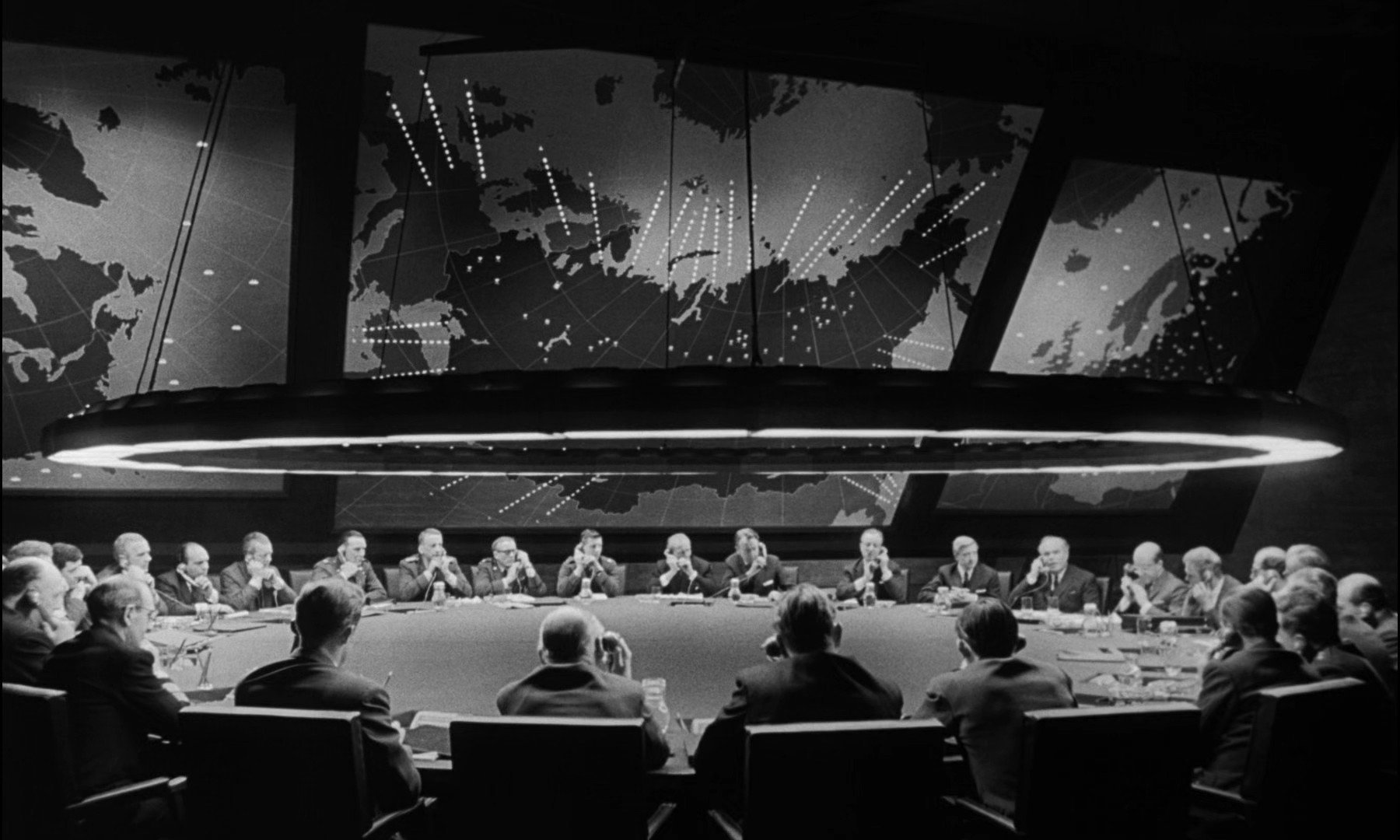
The War Room from
Dr. Strangelove
Whether it’s true or not, the story captures something important: the
immense appeal and attractiveness that the spaces in Kubrick’s films
exude. The War Room in Dr. Strangelove, the rotating command
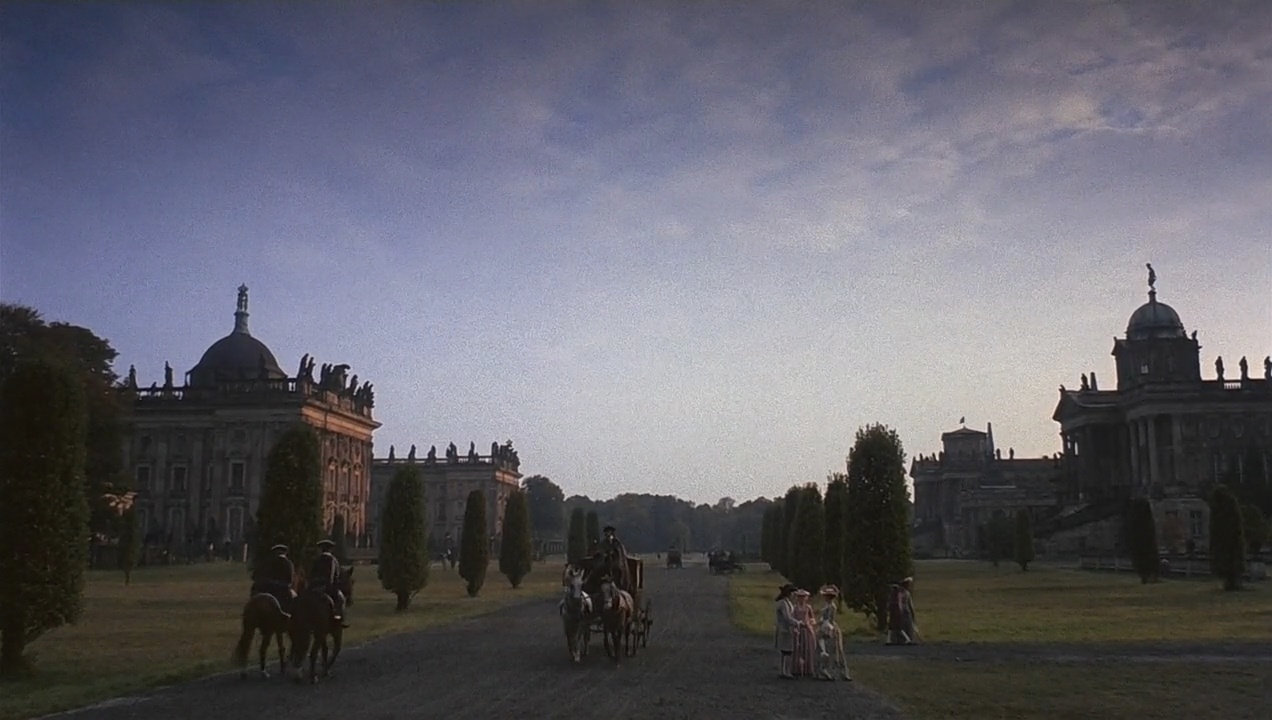
capsule of the Discovery in 2001, the landscapes in Barry
Lyndon, the Overlook Hotel in The Shining – spaces that
you can’t get enough of, that you want to enter, to walk through, that
have a reality that transcends all illusion.
They owe this reality to a texture and depth of field
that was first seen in Jean Renoir’s
La Règle du Jeu and that Kubrick pushes as far as no one had
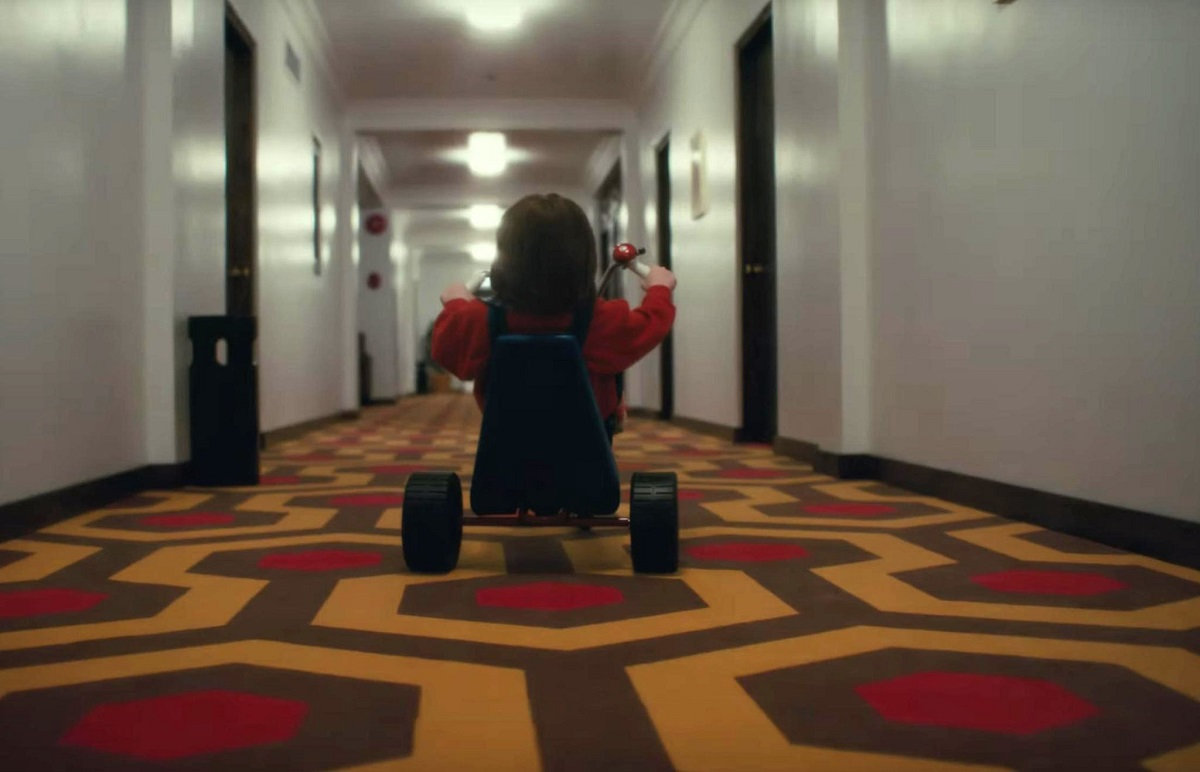
before. Take The Shining: The colours, carpets and wallpapers
of the Overlook, the constant movement further into the space as we
follow Danny on his excursions through the hotel, accompanied by the
alternately rumbling and rustling rolling noise of the go kart, the bang
of the bouncing tennis ball with which Jack Torrance sounds out the
cathedral-like expanse of the lobby, make the hotel almost physically
tangible.
Danny exploring the Overlook Hotel in
The Shining
At the same time, these spaces are not overwhelming like their
counterparts in Spielberg’s films which suck you into the
adventure.On this, see Kolker (2011) who provides an ideology critique of Spielberg’s strategy of
overwhelming the viewer.
In Kubrick’s films, spaces don’t force you; they attract
and entice, they invite you to marvel at them – and ultimately point
beyond their physical tangibility. They aren’t merely a frame for
action, but its object and author.
Space in Kubrick’s work becomes, in a sense, three-dimensional
thought. The War Room is an expression of the Cold War, not its
metaphor. In Paths of Glory, trenches and palaces are
places, not images, of power and war. The Overlook is
the labyrinth in which the inhabitants get lost, not a symbol for this
confusion; the place is the evil, not just its stage – it’s
literally what possesses Jack and thus drives and determines the story.
The space doesn’t symbolise a concept, it embodies it.
And it not only embodies the concept, but also how it is (or isn’t)
grasped – it is at the same time thought turned into place and a place
of thinking. For Bill Harford in Eyes Wide Shut, the labyrinths
of the flat and the city are mirrors of the desires and needs he cannot
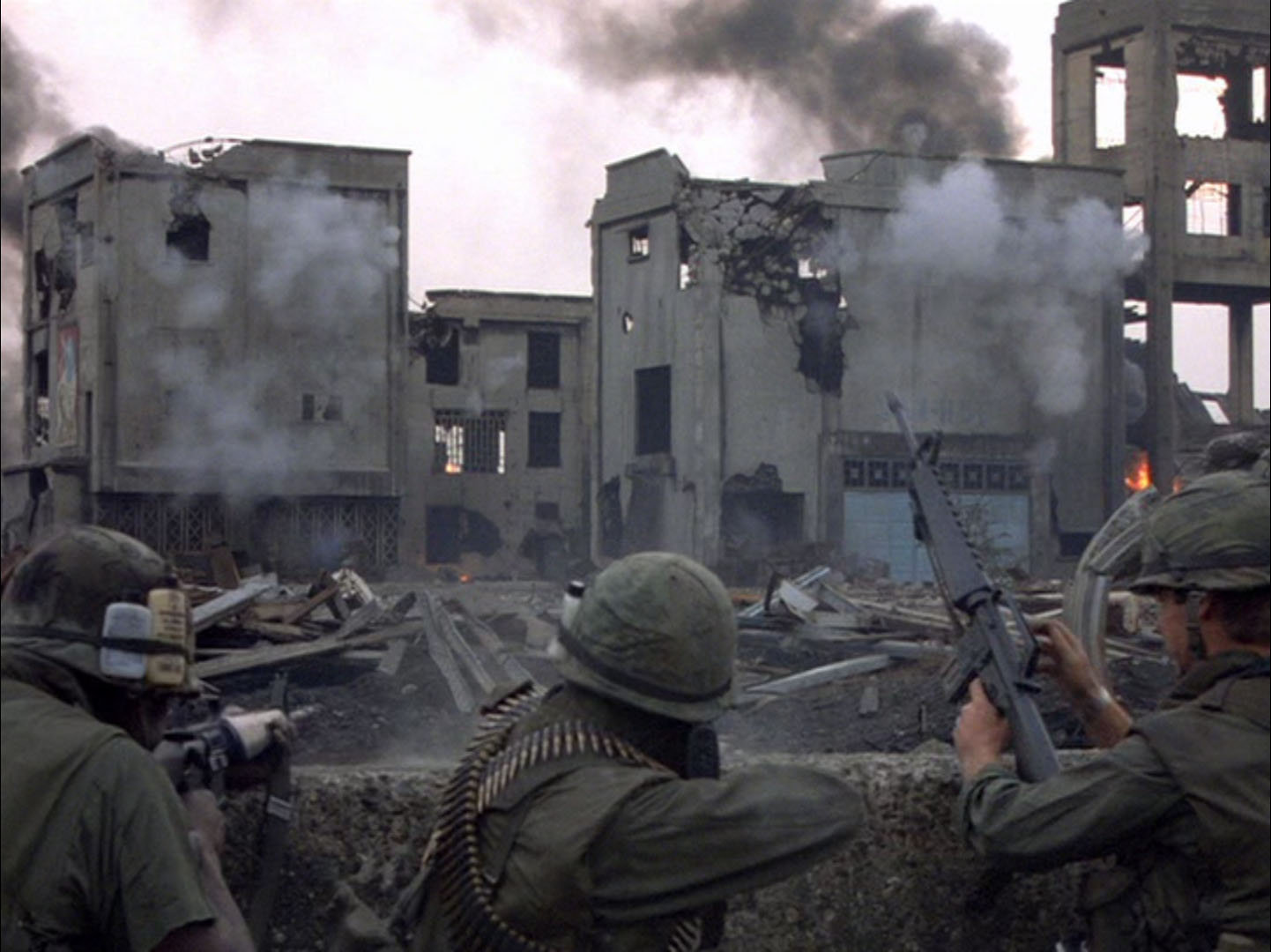
grasp and control; Hué’s field of urban debris is not the backdrop for
the soldiers’ struggle for clarity and direction in Full Metal
Jacket, but its cause, object and obstacle – “the terrain of small
unit action is really the story of the action”, says Kubrick
himself.
The ruins of Hué in Full Metal
Jacket
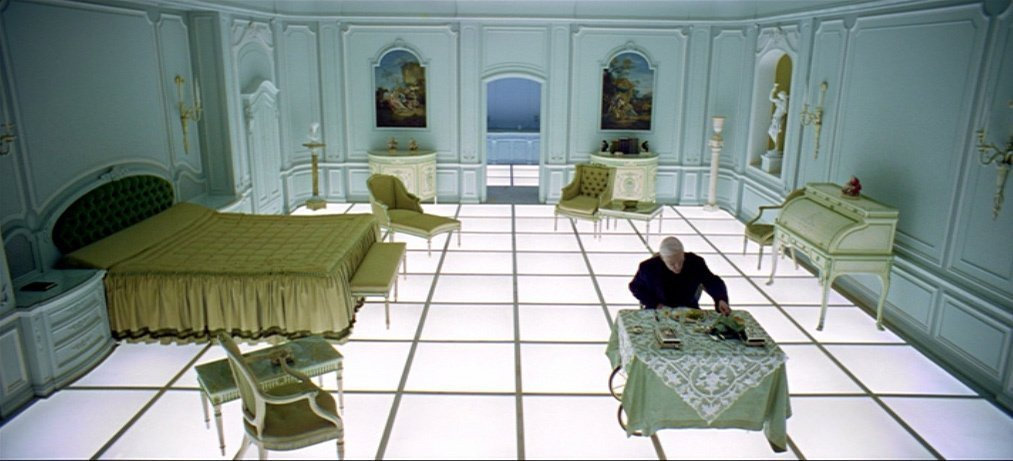
In 2001, we see how Kubrick finally uses space to make
comprehensible what cannot be put into words with the surreal salon
“beyond Jupiter”, where David Bowman’s transformation into the star
child takes place. Kubrick himself said that it functions as a kind of
zoo for Bowman to be observed in by alien beings – it is designed to
make him feel at home, but based on a limited understanding of actual
human surroundings. Kubrick contrasts the salon’s organic shapes with
the artificial light that streams out of the floor, reversing the
setting in the rotating space station seen earlier in the film and
making the space seem as unnatural as it is eerie. The imperfectly
imitated baroque furniture adds the familiarity and distance of
tradition, places Bowman in aristocracy and distant hierarchies
(recalling the Palaces from Paths of Glory), and finally
anticipates his fast ageing, which frees him from all these
references.
The ageing David Bowman in 2001 – A
Space Odyssey
In this way, space narrates the context and causality of Bowman’s
metamorphosis without plot, narrator or shot having to do the work –
Kubrick lets us experience the mythology and metaphysics of the film
without a detour through language.
Perspective
Kubrick is 27 when he shoots The Killing, with Lucien Ballard
directing photography, 20 years his senior and famous for his later work
with Sam
Peckinpah; an experienced cameraman, a professional. Kubrick’s
instructions are clear, but not always comprehensible: He orders a
wide-angle 25mm lens for a style-defining tracking shot from the back to
the front room of the conspiratorial flat. Ballard would have to lay the
tracks so close to the set that lighting would become disproportionately
difficult. So he takes a 50mm lens, moves the camera back and explains
to Kubrick that this will give him the same framing. Kubrick is stunned,
confronts Ballard with the alternative of following his ideas or leaving
the shoot – and wins. The old hand Ballard won’t question any further
decision made by the beginner Kubrick.
Sterling Hayden as Johnny traversing his
flat in The Killing
A trained photographer, often shown next to the camera, at the lens
or behind the video monitor, Kubrick was fanatic of the shot. Its
definition through lens geometry, position and perspective of the camera
was the linchpin of his work on set. It is only because Kubrick insisted
on using wide-angle lenses even in the most intimate shots in The
Killing (repeated and intensified later in Eyes Wide Shut)
that the situations captured are always slightly distorted, that they
speak of a lurking paranoia.
The most famous example of Kubrick’s shot fanaticism, however, are
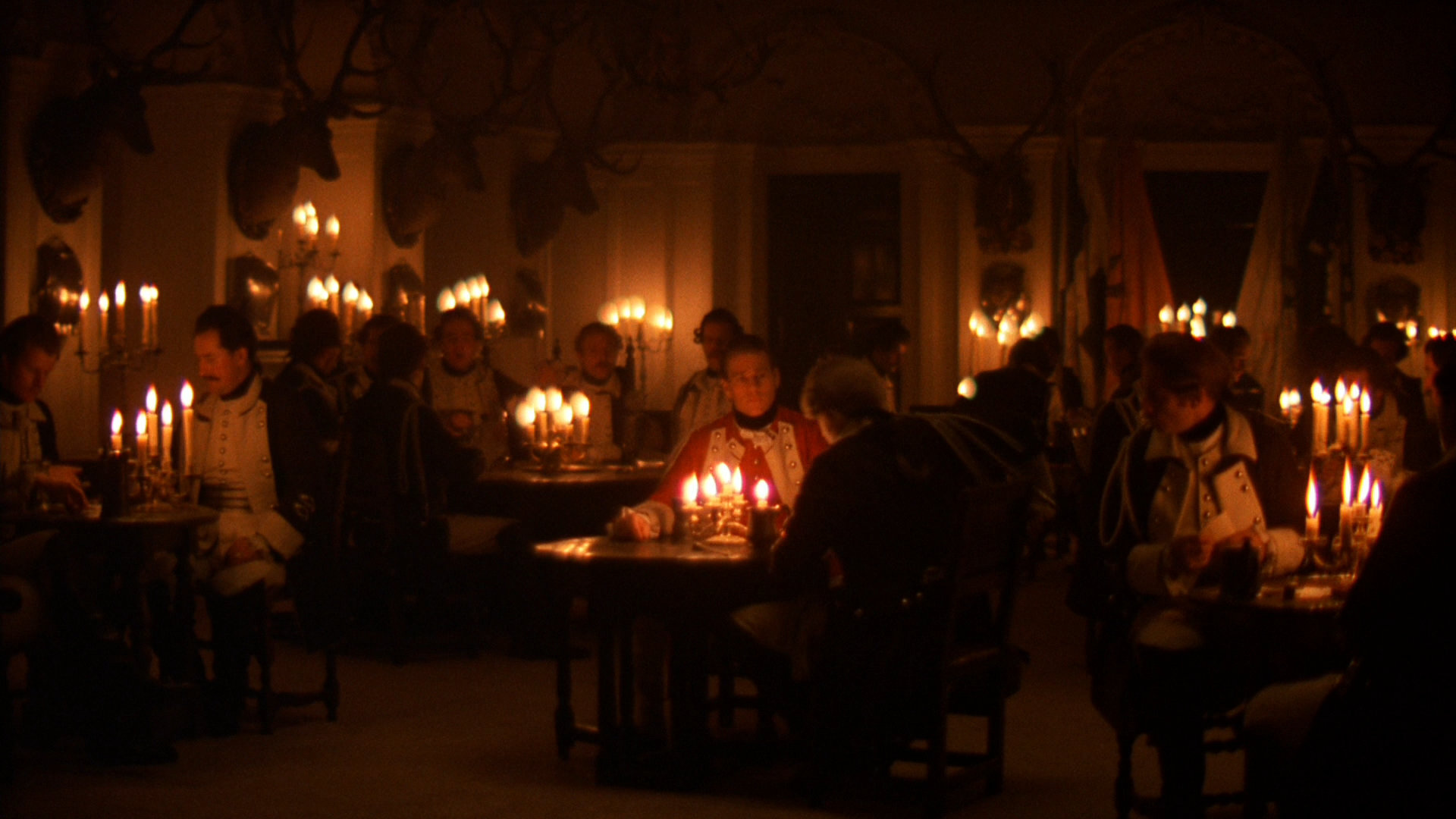
the night-time interior scenes in Barry Lyndon: to be able to
film them by candlelight without additional lighting, he had a Mitchell
camera demolished in order to put the fastest lens ever made in front of
it – a collaboration of Carl Zeiss and NASA, only two of them ever
produced. (A funny footnote is the now widespread narrative
that Kubrick staged the moon landing for NASA and the lens was his
reward.)
A candlelight scene from Barry
Lyndon
The images resulting from Kubrick’s fanaticism are so extraordinarily
clear and unambiguous that there is never any doubt about their
artificiality. There is no threat of being overwhelmed by the setting,
no illusion about our distance from what is happening. Kubrick’s gaze –
and thus ours – is rational, not affective, structuring, not unifying;
“scientific”, says Georg Seeßlen. This gaze does not replicate that of
the participant (unless that is the relevant cognitive perspective), but
orders events and objects for us as viewers: spatial boundaries are
always positioned just inside the image boundaries, camera movements are
tightly controlled, the spatial geometry just as clearly defined as the
movements within it.
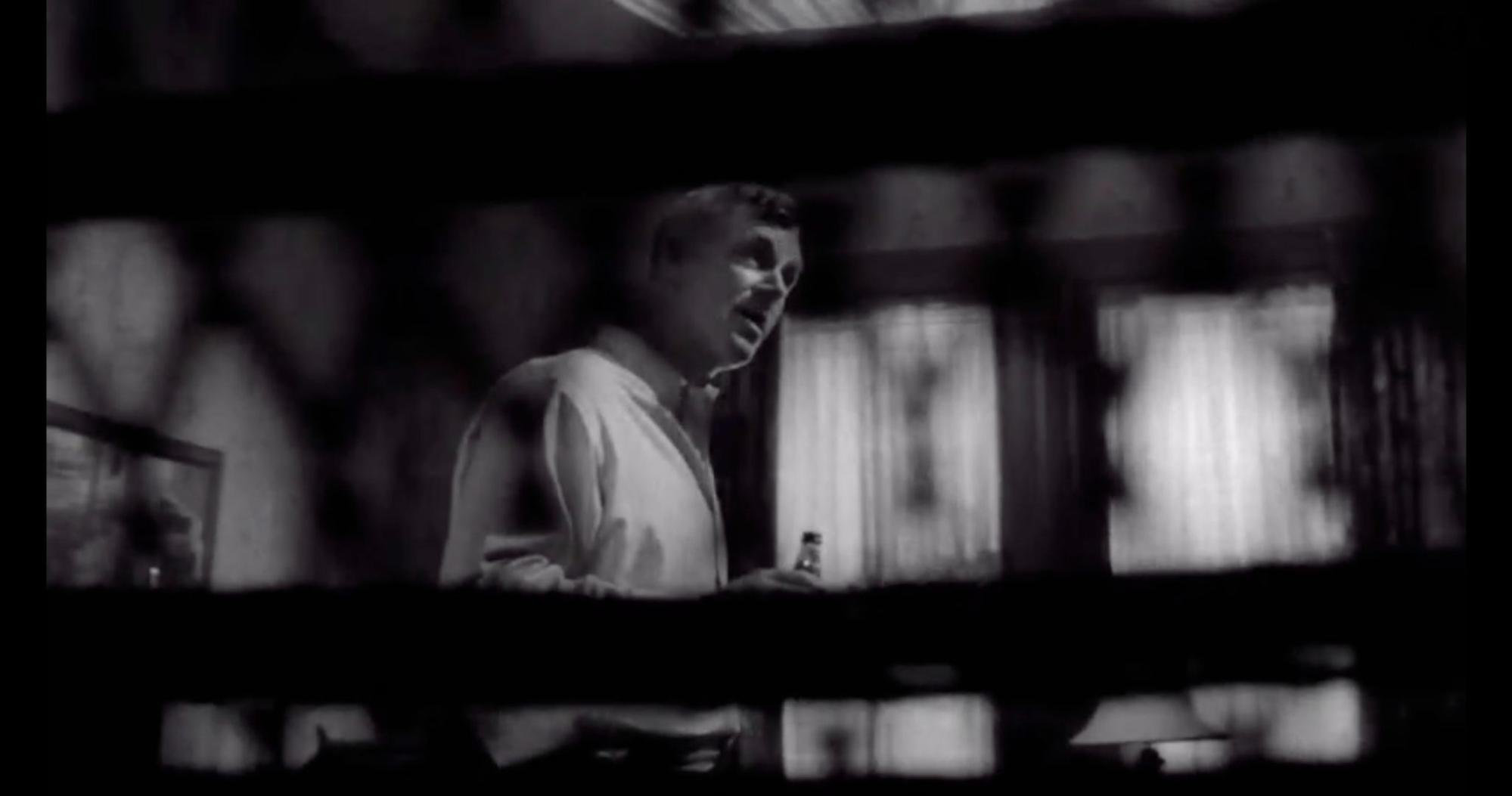
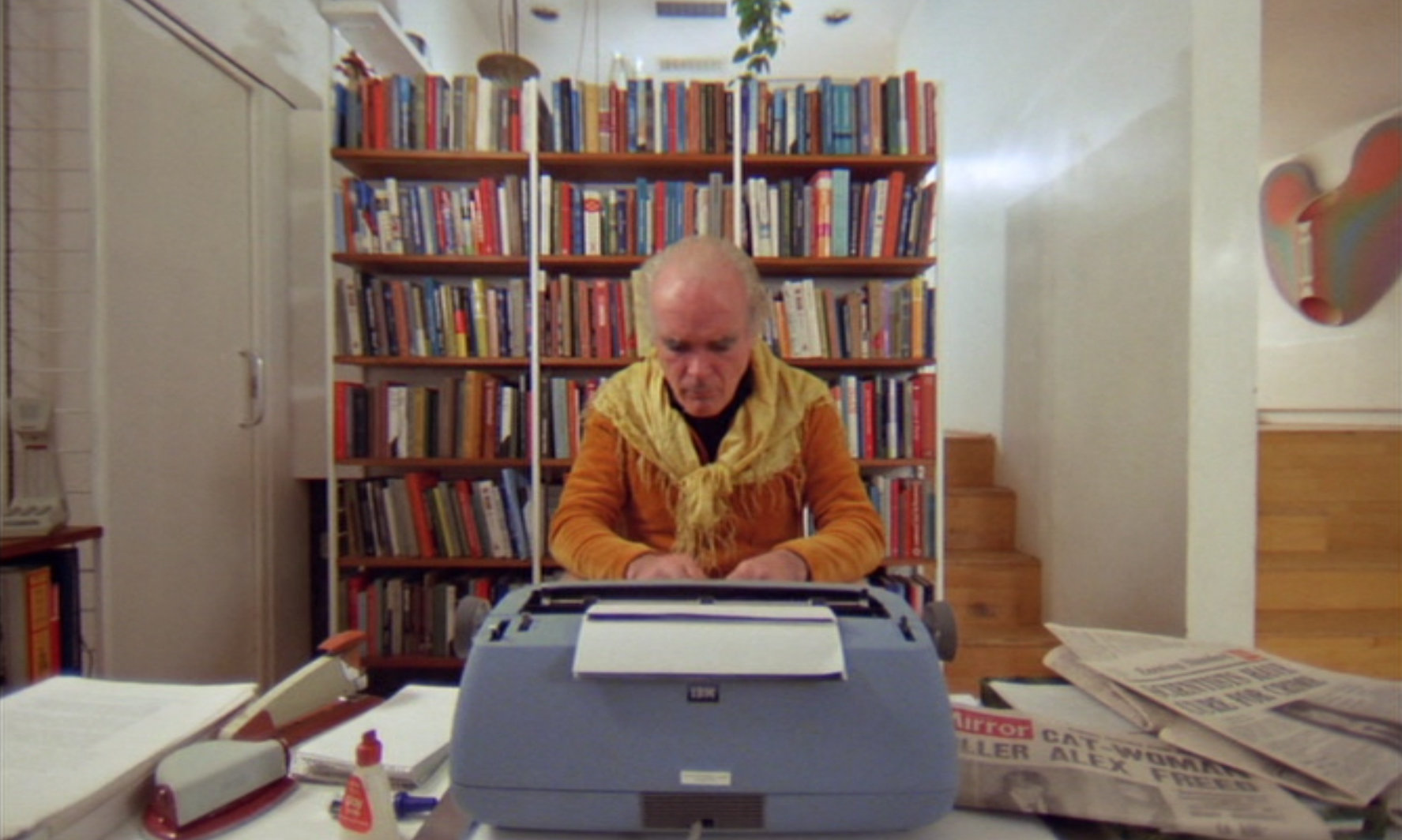
Case in point: two sequences from A Clockwork Orange, which
incidentally quote and continue the journey from The Killing in
terms of plot context and wide-angle optics: The identical parallel
journeys from the writer Mr Alexander’s desk to his wife (and her space
sofa) and his caretaker (and his weight-lifting bench), their way
through the mirrored corridor to the door, and Alex’s two completely
different appearances move as if “on cue”; the geometry of the camera
movement divides the images and the rhythm of our perception, the
differences between the scenes stand out all the more clearly because
their structure is exactly the same. Architecture, interiors and actors
are presented by the camera, not portrayed. In the end, this gaze turns
Kubrick’s hyperreal spaces into “worlds so aestheticised, so
overdetermined that their reality is dubious”, as Larry Gross says about
Eyes Wide Shut.
Mr Alexander in A Clockwork
Orange
With Dr. Strangelove, Kubrick had established his grammar of
shots. Three perspectives dominate: the view from below into the corner
of the room, whose movement is the panning of the camera from a fixed
position; the view at the same height frontally into the room, which is
moved as a parallel movement of the camera; and the handheld camera,
which is used whenever things get real and we are supposed to share the
perspective of the actor(s).
General Ripper in
Dr. Strangelove: camera pointing upwards into an edge of the
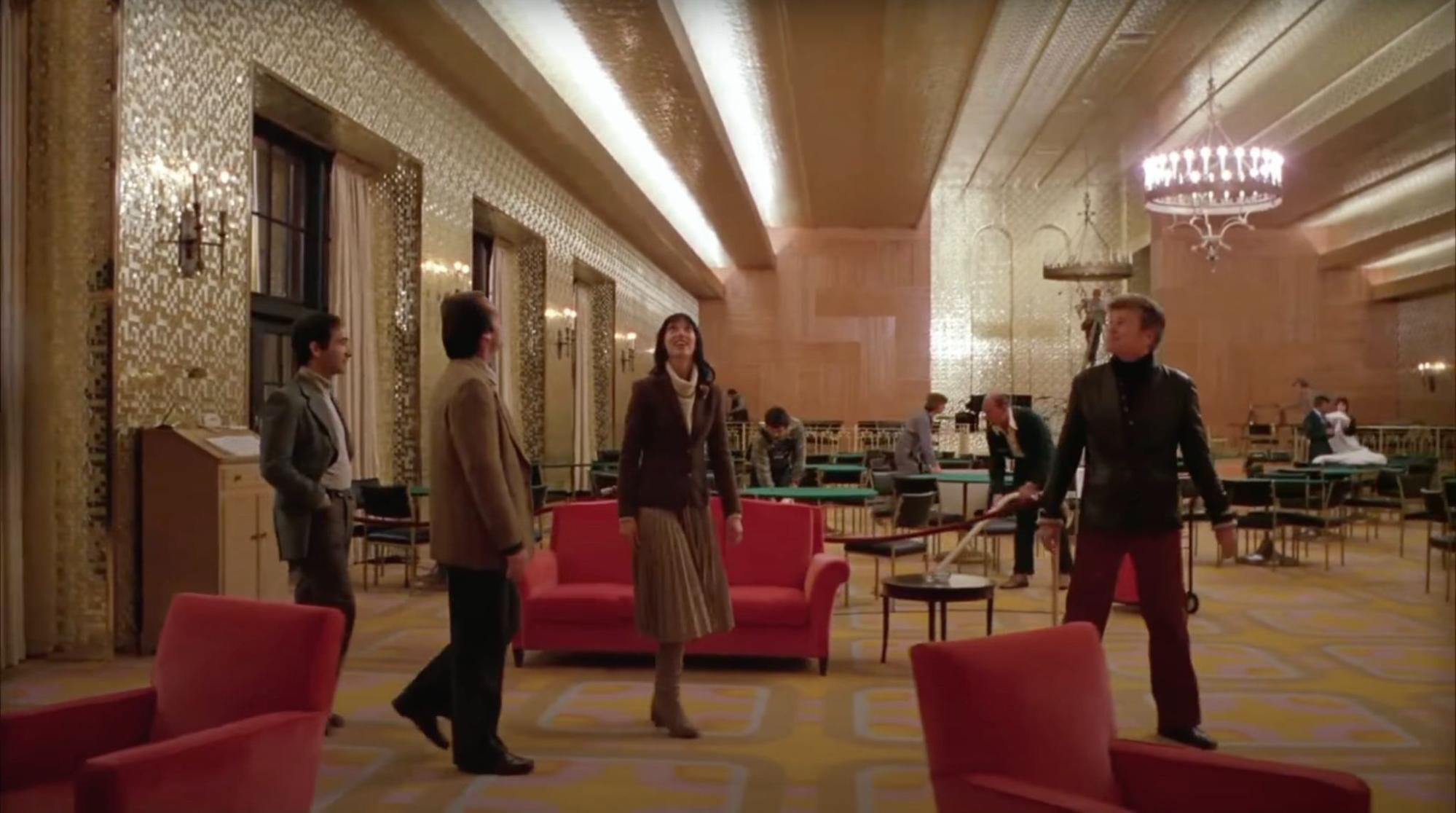
roomAdmiring the Overlook in The
Shining: parallel tracking shot while the protagonists are
movingThe fist fight in Barry Lyndon:
handheld camera in the midst of the action
The view of the delusional General Ripper and how he defends his
office in Dr. Strangelove, the tour of the Overlook Hotel at
the end of the holiday season in The Shining, the fight scenes
in Dr. Strangelove, A Clockwork Orange and Barry
Lyndon are each typical examples of Kubrick’s three perspectives.
They each give the captured scene its specific meaning: We realise
Ripper’s madness not only from the dialogue, but from the way the camera
is looking up to an imposing but cornered general; we experience the
labyrinthian character and overwhelming power of the Overlook Hotel
through long parallel camera journeys following our protagonists. The
adoption of the actor’s perspective reaches its climax when Alex’s
suicidal fall in A Clockwork Orange is shown from his own point
of view, until the camera shatters on the floor (and literally
breaks).
The level of consistency of these perspectives across all films might
be astonishing, but it is precisely the unambiguity and regularity of
Kubrick’s grammar that allows his films to speak on a level that is
largely independent of plot and dialogue.
Just how far Kubrick takes the embodiment of a concept in a
perspective can be seen in the juxtaposition of Barry Lyndon
and The Shining: The former shows our (historical) distance
from the story by making almost every shot a zoom out of or into an
image that could be part of the 18th century canon (and thus reflects
our view of the past as well as the pace of the time). The latter draws
us in with the perspective that is created by the steadicam’s fluid
movement into and through the space and lets us experience the
labyrinthine character of the hotel ourselves.
One of the painting-like shots in
Barry Lyndon
But neither of these things overwhelm the viewer: they are wordless
explanations of the film’s events we engage with because they are so
incredibly tempting and so completely plausible, not because we have no
other choice as e.g. in Spielberg’s case. And the more often we
experience them, the better we know and recognise them, the more
familiar we are with Kubrick’s grammar, the more willingly we accept
these explanations. And the better we understand Kubrick’s films.
Montage
The early Kubrick, it is said, was above all other directors
influenced by Max Ophüls and
his long, smoothly moving shots. When he talks about montage, Kubrick
does not refer to Sergei
Eisenstein, but to Vsevolod
Pudovkin: the cut should not connect sometimes disparate impressions
for purposes of agitation and argumentation, but string together images
“step by step”, each images being the “direct continuation of the
others”, so that “each shot gives the incentive to transfer interest to
the next”. Kubrick’s films should therefore be entirely organic.
But already The Killing demonstrates that they actually
function completely differently: Anticipating Tarantino & Co, the
film deliberately cuts up all temporal and causal structure and arranges
the material in such a way that we have to reconstruct these connections
ourselves, but the patterns and motifs behind them are expressed all the
more clearly. This interplay between the involvement of the viewer and a
complete formulation of the concept characterises all of Kubrick’s films
and makes them, for both the recipient and the author, works that are,
also in the montage, conceived, not felt. (How different from the great
antipode Tarkovsky!)
On the one hand, this applies to the macrostructure of the films,
whose story is always visibly and precisely divided into
“non-submersible units”, such as Burpelson Air Force Base, War Room and
B-52 bomber in Dr. Strangelove, “The Dawn of Man”, “18 Months
Later” and “Jupiter and Beyond the Infinite” in 2001, or Parris
Island, Da Nang and Hué in Full Metal Jacket. In addition, and
similar to classical drama, they develop in clearly separated acts,
usually four of them. In The Shining, for example, these are
the way to the hotel, moving in and making a home, the way into madness,
and climax and death.
On the other hand, the editing places the individual scenes in a
rational, not an emotional relationship to each other: In Paths of
Glory the cuts from Colonel Dax to the soldiers on his tour through
the trenches as well as those from the labyrinth of the battlefield to
the palace halls of the military leadership explain domination and
hierarchy, contrasting realities of life whose incompatibility fuels the
fundamental conflict of the film. Thoughts, not feelings, are
conveyed.
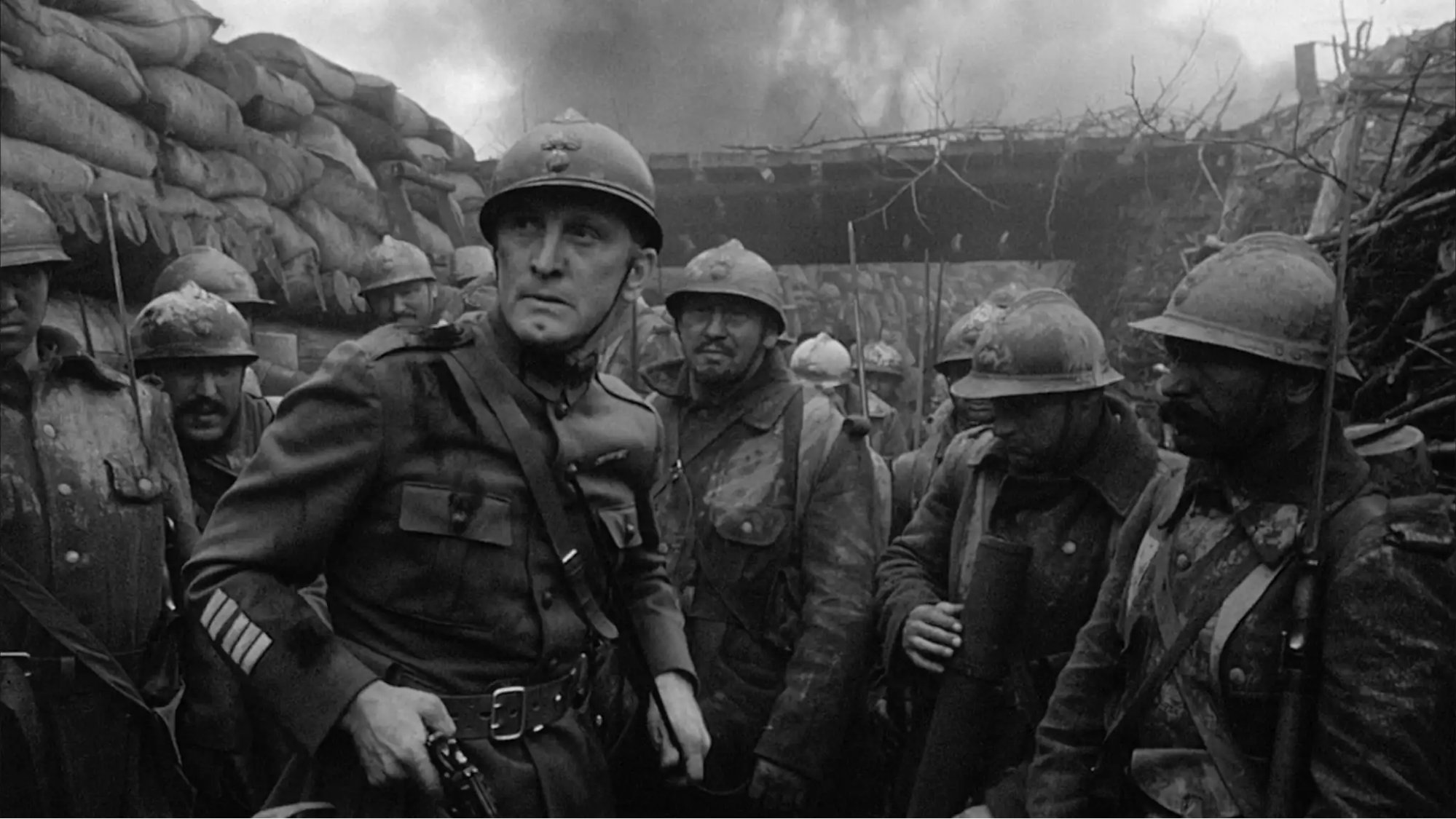
Colonel Dax in the trenches with “his”
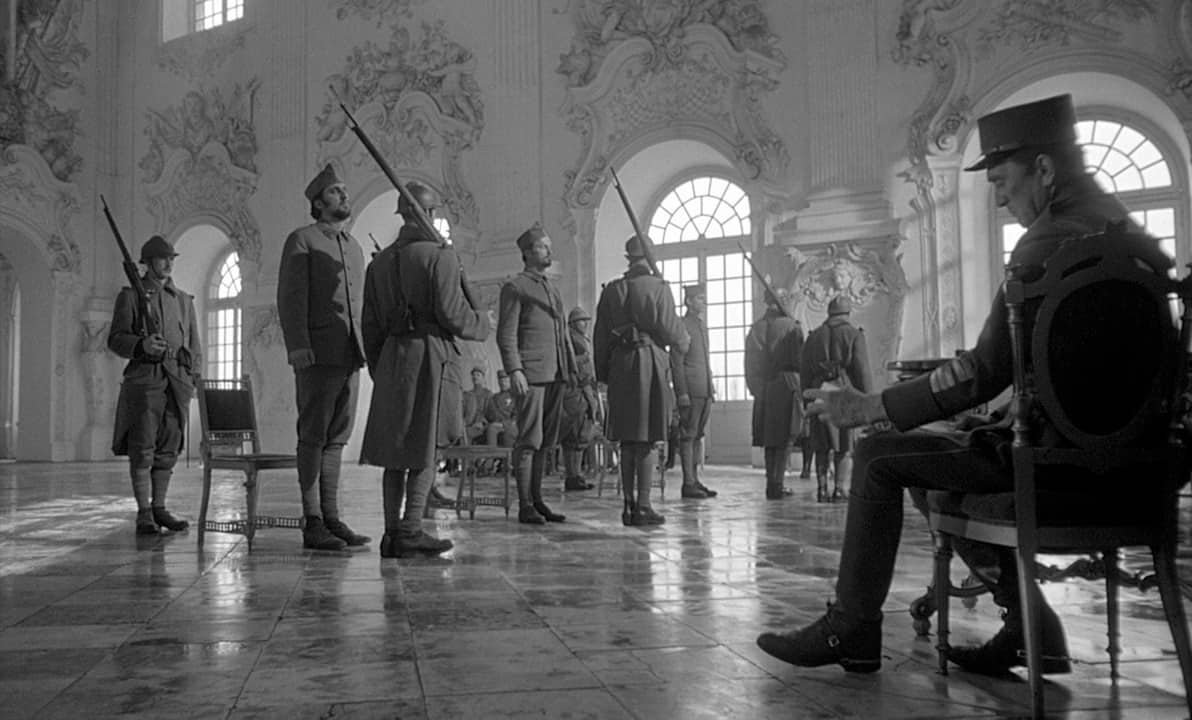
soldiers in Paths of GloryArmy headquarters in the local palace in
Paths of Glory
The same is true of the cuts in Barry Lyndon, which act as a
counterpoint to the long takes and zooms that dominate most of the
film’s sequences: They do not support the comprehensibility of the
emotions shown or increase the pace and thus the brisance of Barry’s
rise and fall, but primarily heighten our awareness of the slow pace
within the shots and thus of our conceptual as well as cultural distance
from the events. The fact that this makes the film seem like a walk
through a museum, as main actor Ryan O’Neal one said disapprovingly, is
only testimony to this deliberately created distance, which for Kubrick
is the only justified and authentic approach to a bygone era.
Finally, the probably most famous cut in film history, the match cut
from a bone thrown into the air to a military spaceship in Earth orbit
in 2001. It represents the essence of Kubrick’s intellectual
montage. Not only does a single cut cover a temporal distance of three
million years; at the same time, the matching of the two objects shows
the continuity over this distance and the path that humanity has
travelled: it has conquered space with tools designed for a struggle for
power and supremacy that began millions of years ago. The cut expresses
a general theme of the film, a theme that finds its culmination in the
figure of HAL 9000 and the conflict between dehumanised humans and
all-too-human machines.
The two images of 2001’s famous
match cut
The incorporation of the form and movement of the preceding shot into
the following one thus doesn’t serve the organic continuation of a
series of images, but is the condition and means of Kubrick’s
argumentation in and with images. In this, it is closer to the
“argumentative cut” of the late Eisenstein than to Pudovkin’s smooth
montages.
Author and audience
Kubrick is often wrongly categorised as an auteur. What distinguishes
true auteur filmmakers like Hitchcock, Truffaut
or Scorsese
is the personal view, the autobiographical reference, the pervasive
subjectivity of their filmmaking. All this is missing in Kubrick. His
eagerly secured and preferably exclusive screenplay credits (“the auteur
syndrome” Terry
Southern, his co-author on Dr. Strangelove, called it) are
the only reference to the – in Umberto Eco’s words – empirical
author Kubrick.Eco (1990)
Scorsese’s origins and cinematic socialisation can be found in
abundance in the themes and topoi of his films. Truffaut’s admiration of
Hitchcock speaks from his entire oeuvre, and Hitchcock’s obsessions are
essentially the material of his thrillers. Kubrick’s content and the
form he gives it don’t reference anything personal. The author takes a
back seat to the work. Kubrick’s refusal to comment on his films, his
complete retreat into the private sphere fit perfectly into this
picture.
The only thing that remains of the author Kubrick is his method,
which, in Eco’s framework, constitutes the model author.Ibid.
It makes the rational perspective and the theoretical
nature of Kubrick’s films possible in the first place. Kubrick’s films
speak to us with clarity and unambiguity because of his endless
perfectionism, the insistence on absolute control, the thinking through
and designing of all aspects. “The ideal way to make a film would be to
wrap up after every scene and go away for a month to think,” Kubrick is
reported to have said – and his way of working came very close to this
ideal.
The disappearance of Kubrick the empirical author also opens up new
perspectives on the – notably un-filmic – off-screen narrator, which
Kubrick uses in every film except 2001, The Shining
and Eyes Wide Shut. The classic and certainly accurate
justification is that a narrator frees setting and dialogue from
delivering exposition or highlighting emotions. This allows camera and
editing to concentrate on showing rather than explaining, and thus be
pure film. At the same time, the narrator can add levels of meaning –
e.g. establish complicity with the protagonist as in A Clockwork
Orange or create suspense (instead of surprise) in Barry
Lyndon. In Kubrick’s work, the off-screen narrator is always in
service of the concrete film, not of an ideology of filmmaking.
From the point of view of the author stepping back behind his work,
the additional narrative instance takes on further significance: by
inserting an invisible, but identifiable voice, a further level of
abstraction is created between the viewer and the author. The narration
through shot and cut, which bears Kubrick’s signature, is relativised by
the off-screen narration, further minimising the relationship to the
empirical author. Kubrick makes himself invisible.
At the same time, however, the additional voice creates space for
narrative incongruities – and with them possibly a glimpse of the
empirical author, the human being Stanley Kubrick after all, even if he
himself speaks of the “objective reality” shown in the pictures. In a
film that is otherwise shown entirely from the perspective of his
first-person narrator (A Clockwork Orange), it is striking that
there are exactly two scenes that the “humble narrator” Alex cannot have
experienced. That his victim and later patron Alexander is less a
democrat than an aristocrat (“They have to be led!”); that he sees
through Alex and, continuing to mimic the benevolent host, plots against
him; how he exposes Alex and what he sets in motion against him – we see
all this, although Alex can’t possibly witness it. This in turn opens up
the possibility that this interpretation of events, the exposure of the
liberal Alexander as just another scheming cheapjack play-actor, springs
from Alex’s imagination and only serves his self-protection. The
additional narrative instance thus creates space for a sceptical
optimism that Kubrick is otherwise all too often denied.
A maddened Mr Alexander in A
Clockwork Orange
While Kubrick the empirical author almost completely disappears
behind the model author, the importance of the empirical reader
can hardly be overestimated. For all of his consistency and control, few
directors were more uncertain about the actual impact of his films than
Kubrick. Alongside forced decisions (the lack of sex in Lolita) and
omissions justified by film logic (the missing
cake fight in Dr. Strangelove), radical re-cuts were
sometimes made under the impression of audience reactions: After some
audience members left the premiere of 2001 early, Kubrick
removed 20 minutes of film – which is why, for example, the waltz of the
Orion III approaching to the space station seems to miss a few steps.
Kubrick cut the final sequence from The Shining after the first
screening – and another 28 minutes for the European version of the film.
The digital fig leaves in the orgy sequences of the US version of
Eyes Wide Shut reportedly had his approval. And his first film,
Fear and Desire, will probably never be seen again – Kubrick
bought all existing copies and locked them away. No small price to pay
for perfectionism.
The famous “space waltz” from 2001: A
Space Odyssey
Epilogue
Those who accuse Kubrick of coldness and cynicism may find
confirmation by all the intellectuality and distance that characterise
Kubrick’s films. In reality, however, they are the condition for an
endeavour that speaks of a deep humanity: making films about the world
and our place in it that look sceptically behind the myths and
mechanisms of everyday life.
Of course it is easier to make films about how the world should be or
how we feel in it. But such films are mostly either superficial or
cathartic, serving primarily emotional needs in both cases. For Kubrick,
on the other hand, films about our world and our place in it must deal
rationally with its irrationality, reflect on the conditions of their
knowledge production, and give an honest account of their
positionality.
Thus if one doesn’t want to make superficial or cathartic films, but
films geared towards learning and understanding, then the detached,
examining, not the feeling gaze is a prerequisite for their
truthfulness. To understand cinema as a place of thinking, not of
feeling is a consequence from this that breaks with the tradition of
conventional narrative cinema. Kubrick has drawn it radically like no
other film maker. He was never indifferent to the fate of humanity and
the fate of humans – he just continues to ask and think where others are
satisfied with a sigh and/or a sob.
Kubrick said of Arthur Schnitzler in 1960: “It’s difficult to find
any writer who understood the human soul more truly and who had a more
profound insight into the way people think, act, and really are, and who
also had a somewhat all-seeing point of view – sympathetic if somewhat
cynical.”
Kubrick and his work could not be described any better.
Jung & Seeßlen (1999): Stanley Kubrick und seine
Filme
Kolker (2011): A Cinema of Loneliness (4th edition)
Walker (2000): Stanley Kubrick, Director: A Visual Analysis
(revised edition)
Acknowledgements
The stills from the films discussed in the essay are used for
educational purposes, constituting a fair use of copyrighted
material.
I am grateful to Michael Wopperer, Gregor Groß and the Motorhorst community for comments
on earlier versions of this essay.
]]>Knowledge and Ideology in the Anthropocene2022-06-06T00:00:00+01:002023-10-14T03:40:02+01:00http://localhost:4000/knowledge-ideology-anthropoceneThe Anthropocene seems to have a paradoxical relationship with
knowledge.
On the one hand, it’s often describedE.g. in Lewis & Maslin (2018) and Harari
(2015).
as the result of a centuries-long exponential
growth of knowledge fuelled by investment: The interlocking
feedback loops of capitalism and science – “the investment of profits to
generate more profits, and the production of ever-greater knowledge from
the scientific method”Lewis & Maslin (2018), 14
– have acted as “history’s chief engine for the past 500
years”Harari (2014), 306
and made “Homo sapiens […] a geological superpower”Lewis & Maslin (2018), 5
.
On the other hand, the Anthropocene is also seen as the result of a
centuries-long lack of knowledge – the work of “a ‘humanity’
deficient in knowledge”Bonneuil & Fressoz (2016), 65
that unwittingly set “Earth on a new path in its long
development”Lewis & Maslin (2018), 5
, characterised by climate and ecosystem breakdown.
Climate scientists express this widespread view when they claim that
“[w]e are the first generation with the knowledge of how our activities
influence the Earth system”.Steffen et al. (2011), 757
Taken together, these narratives paint the picture of a
civilisationThe globally integrated complex system that encompasses
most of today’s societies, economies, cities and smaller social systems
and their economic, political, military, diplomatic, social and cultural
interactions.
that is in crisis because it was at the same time smart
enough to exponentially increase its impact on the planet and too stupid
to understand the consequences of that.Until recently, this has been more or less my own view;
see the first section of my “Complexity, Metaphor and
Radical Change”.
But this picture is misleading and dangerous. It wrongly models
collective knowledge on a specific conception of of individual
knowledge, distorts historical facts, obscures the true causal structure
of our situation, and makes effective action in the face of our
existential crisis less likely. Clearing up this misunderstanding will
help us understand what really brought us into our current predicament –
and how we can take steps beyond it.
Varieties of knowledge
So, what is knowledge?
Let’s start with our pre-philosophical, everyday understanding of it.
The Oxford Dictionary of English begins its
definition as follows: knowledge is “facts, information, and skills
acquired through experience or education”.
There are two different types of knowledge in this definition:
knowing that – for example, I know that there is a
dictionary, and I know that the dictionary defines knowledge in this way
(a fact about which I have information);
knowing how – for example, I know how to use the dictionary
to look up this definition (a skill).
The first type is also called propositional knowledge and is the
mainstay of philosophical theories of knowledge. Textbook
introductionsSee, e.g., Pritchard (2010).
usually spend a paragraph describing knowing
how, another paragraph explaining why it’s derivative, and the
remaining pages on knowing that.There are a few notable exceptions, first and foremost
Ryle (1949).
This dominance rests on “the common assumption that reality has a
propositional structure or, at least, that the proposition is the
principal form in which reality becomes understandable to the human
mind”.Zagzebski (1999)
Research into human perception and cognition suggests that this
assumption is wrong.This argument has been made early on by Craik (1943),
who states that thought’s “essential feature is not […] propositions but
symbolism, and that this symbolism is largely of the same kind as that
which is familiar to us in mechanical devices which aid thought and
calculation.” Of course such a position has to be naturalistic,
i.e. understand these questions as empirical ones.
On the most fundamental level, our brain makes sense of
the world using generative or predictive models.For summaries of the research on predictive processing
see e.g. Clark (2013) and Seth (2021).
Reality is just a causal constraint on these models.
Explicit and Implicit Models
A generative model
aims to capture the statistical structure of some set of observed
inputs by tracking […] the causal matrix responsible for that very
structure. A good generative model for vision would thus seek to capture
the ways in which observed lower-level visual responses are generated by
an interacting web of causes – for example, the various aspects of a
visually presented scene.Clark (2013), 2
In other words, a generative model predicts the causes for what
we perceive.
This can happen on multiple levelsSee Ramstead et al. (2019) for “a multiscale ontology
of cognitive systems“, i.e. a framework for integrating accounts of
systems on these different levels.
, from individual perception to scientific explanation:
our brain tries to figure out (predicts) the objects and movements that
cause our visual perception; a scientific model tries to figure out
(predicts) the systems and processes, entities and laws that cause
experimental observations.
From this perspective, a third type of knowledge appears to be more
fundamental than the two we’ve encountered so far: knowledge
of, or what the dictionary describes as “the theoretical or
practical understanding of a subject”. We can now define this
understanding more technically as having access to a generative
model of a subject.
We get from knowledge of to knowledge that if we
“think of models as entailing propositions”Bailer-Jones (2009), 186
: They are predictions about how our environment will
behave, derived from explicit models. Explicit models are
consciously articulated, interpretive descriptions of our environment,
and we pay active attention to them in order to use them.
Knowing how is based on models, too – implicit
models, in this case: non-conceptual, embodied representations of
our environment that we use unconsciously. Implicit models are at the
heart of every skill; their embodiment can consist in practices, habits,
instincts, and all other parts of our phenotype, from basic body
structure to hairstyles, from language to calluses.In this respect, it corresponds to what Polanyi (1966)
called tacit knowledge. Holland (1995, 33) takes up this label
to “distinguish two kinds of internal models, tacit and
overt. A tacit internal model simply prescribes a current
action, under an implicit prediction of some desired future state, as in
the case of the bacterium. An overt internal model is used as a basis
for explicit, but internal, explorations of alternatives, a process
often called lookahead.” This distinction is co-extensive to the one
made here.
In other words, “an agent does not have a model of its world
– it is a model”. Friston,(2013), 213 (my emphasis)
Take a fish as an example: its body “can be considered to
be an implicit model of the fluid dynamics and other affordances of its
watery environment.”Seth (2015), 6
If we think about models in this way, it becomes clear that every
system is a model of its environment – at least every stable system that
survives in its environment (which is the type of system we’re usually
interested in).ibid., 156
This holds for all scales, from single cells and organisms to,
importantly, social systems:Ramstead et al. (2019).
a team models its organisational environment, a company
models its market situation, a civilisation models the world it
inhabits.
This requires us to rethink what collective knowledge is: It is not
the aggregation or collective adoption of individual knowledge, of
explicit models available to individual attention and expressed in
books, papers, and databases. It is access to explicit and implicit
models at the level of the collective – the models social
systems have of their environment.
Technology and Techne
Explicit collective models are realised as
technology. We can think of technology as “a programming of
phenomena to our purposes”, a “purposed system”.Arthur (2009). This understanding resonates with
Heidegger’s view of technology as the practice of turning everything
into a means: “Everything approaches us merely as a source of energy or
as something we must organize.” (Blitz 2014)
This gives us a usefully broad scope of the concept,
including entities like “monetary systems, contracts, symphonies, and
legal codes, as well as physical methods and devices”.Arthur (2009)
Technology is combinatorial (technologies are combinations of
existing components) and recursive (these components are themselves
technologies).ibid.
As a result, the models realised in any higher technology
(that combines more basic technologies) cannot be held individually
anymore:
[T]echnology becomes a complex of interactive processes—a complex of
captured phenomena— supporting each other, using each other,
“conversing” with each other, “calling” each other much as subroutines
in computer programs call each other. The “calling” […] is ongoing and
continuously interactive.ibid.
It is therefore collective actors (i.e. social systems) who hold the
models: teams, institutions, communities, industries, economies,
civilisations – depending on the recursion level and timeframe under
consideration, and on whether we look at an individual technology or
bodies of technology (from specific domains to technology as a whole).
But all of these technologies “are developed not by a single
practitioner or a small group of these, but by a wide number of
interested parties.”ibid.
So technology is what social systems collectively design, use and pay
attention to, from electricity and electronics to meetings and markets,
to realise their purpose. It thus contains one end of a spectrum of
social practices: “explicitly coordinated behavior that is
rule-governed, intentional, voluntary”.Haslanger (2018), 235
At the other end of this spectrum are
patterns in behavior that are the result of shared cultural schemas
or social meanings that have been internalized through socialization and
shape […] cognition, affect, and experience.ibid.
Taken together, social meanings – from concepts like nation,
race, and gender to scripts for behaviour in specific social situations
– and “skills for interpretation, interaction and coordination that we
exercise ‘unthinkingly’”ibid., 158
constitute a cultural technēA term coined by Haslanger (2017, 2018, 2019,
2021).
:
a network of social meanings, tools, scripts, schemas, heuristics,
principles, and the like, which we draw on in action, and which gives
shape to our practices”Haslanger (2017), 155
These are “the sources of our practical orientations, that is, the
social preconditions for thinking and acting”Haslanger (2019), 11
– and, a fortiori, the foundation technology rests upon.
A cultural technē thus realises the implicit model of a social
system: the “part of a system that functions […] to regulate our
interactions in a domain”ibid., 156
.
Just as an individual implicit model emerges from the
interactions of a biological system’s components, a social system’s
collective implicit model emerges from the interactions of its
components, from people and artefacts to ideas and institutions.This conceptualisation of social systems is close to
DeLanda’s Assemblage Theory (DeLanda 2005). I regard the of kinds of
things just named as equally real, but ultimately existing as patterns
in a high-dimensional state space. See my “From Predictive Processing to Topological
Thinking: Prolegomena to a Future Paradigm”.
It is not an achievement of conscious individual action
or an aggregation of individual models, but an emergent property of the
larger system.
We can now map out the varieties of knowledge we have found in the
following way:
Individual
Collective
Explicit
Knowing That
Technology
Implicit
Knowing How
Cultural Technē
Types of knowledge
We can use this map to help us understand why our civilisation is in
crisis – and to expose what is just a smokescreen explanation for this
fact.
Our Failing World Model
Collective knowledge on the civilisational level is our
civilisation’s (explicit and implicit) model of its environment (“the
world”). A model that has been quite useful, judging from humanity’s
evolutionary success in terms of growth, spread, and environmental
transformation.See Lewis & Maslin (2018) for a history of this
impact.
(This is the perspective of the “growth of knowledge
enables the Anthropocene” narrative.)
Of course today we see that it is exactly growth, spread, and
environmental transformation that massively threaten our survival as a
civilisation (and possibly as a species).See Servigne & Stevens (2020) for an
overview.
This suggests that the impact of these phenomena on the
Earth System and thus on our collective future is not tracked in our
civilisation’s model of the world; otherwise it would behave
differently. (This what the “lack of knowledge enables the Anthropocene”
narrative highlights.)
In other words, our model of the world is failing.
The most common hypothesis why it is failing is this: Humans just
can’t comprehend complex systems, nonlinear change, and long causal
chains because they’re not evolutionary equipped for that – it wasn’t
necessary in our original cognitive niche.
But it is fundamentally flawed: It assumes that our
civilisation’s collective model (the one that is failing)
amounts to the collective adoption of individual models (the
ones that are constrained by our cognitive capacities) – and we have
just seen that this is not the case.
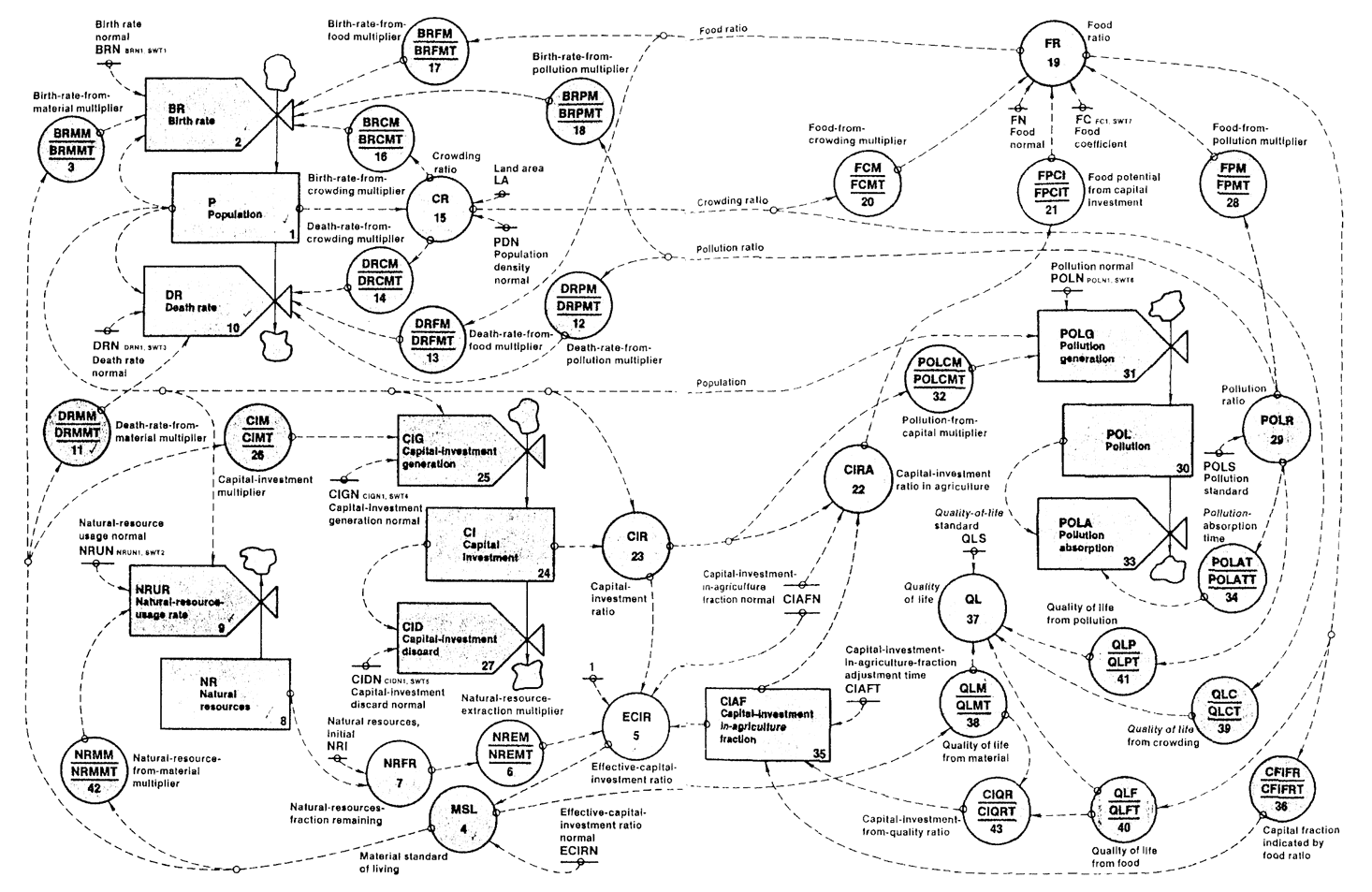
The Famous World3 Model
For an illustration, consider the famous “World3 Model”. It
describes interactions between world population, industrial growth, food
production and limits in ecosystems, and provided the foundation for the
influential 1972 Club of Rome report The Limits to Growth. It’s
an (explicit) individual model that shows what’s apparently missing from
our civilisation’s (implicit) collective one: that we’re part of a
giant, growth-producing feedback loop that we have to stop to avoid
overshoot and collapse.
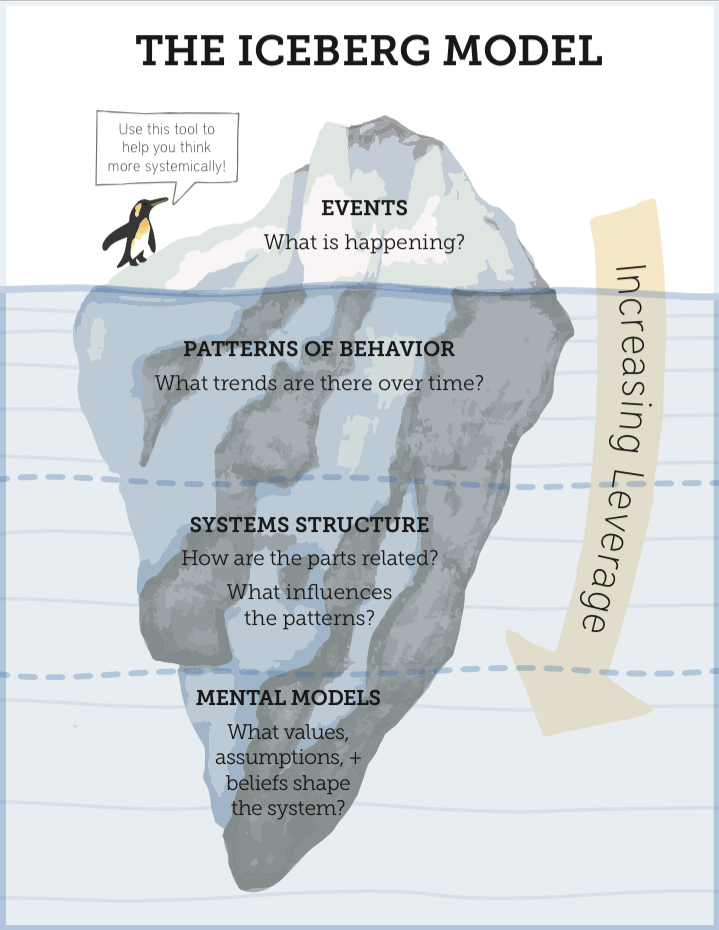
The Equally Famous Iceberg
Model
But why has it not been adopted and changed our collective behaviour
in the 50 years since its conception, replacing our failing model? That
was the explicit goal of Dennis and Donella Meadows and their
collaborators when they initially proposed it: to replace an inadequate,
reductionist model of the world with a better, holistic one. Donella
Meadows describes this strategy in her famous Iceberg
Model: the point of greatest leverage to change a system’s
behaviour, she contends, is shifting the mental models that shape
it.
Talking of mental models in this context points to the heart
of the problem, though: Meadows’s strategy disregards how collective
knowledge is actually realised – a social system’s model is an emergent
result of its components’ interactions, not the collective adoption of
explicit individual models. In effect, she’s trying to replace an
emergent collective model with the collective adoption of an individual
one – which will fail, however much effort one puts into its
promotion.That might be one of the reasons why Meadows changed
her tune slightly in Meadows (1999). There she describes societal
paradigms, “shared social agreements about the nature of reality”
(Meadows 1999, 18), still very much as models that can be made explicit
and changed by influential actors like Copernicus or Einstein. But
beyond that she now recognises a need to transcend paradigms altogether,
which – while still portrayed as an individual activity (ibid. 19) – is
quite close to the therapeutic approach towards ideology described
below.
This brings us back to the question, which we can now put more
precisely: Why is our emergent collective model of the world, realised
in (social and material) technology and, more fundamentally, our
cultural technē, failing?
Ideological Oppression
Quite simply because “a cultural technē can go wrong”Haslanger (2021), 28
: It can become an ideology that distorts and
hides aspects of the world the perception of which would question or
threaten the existing social order.This conception of ideology follows Haslanger (2017,
2018, 2021) and goes back to Althusser and the Marxist understanding of
ideology as false consciousness.
This leads us to an alternative hypothesis about why our
model fails: because it is ideologically captured and
distorted.
Far from being incapable of insight into complex systems, people have
made alarming predictions about the trajectory of our current
civilisation as early as the 18th century. So it was possible to develop
and promote adequate explicit models of our world – but they have been
consistently marginalised by ideological oppression.See Bonneuil & Fressoz (2016).
Ideological oppression is an emergent property of the complex system
that is our civilisation: a product of the dominant incentive system,
and a set of systemic constraints on individual behaviour.See Juarrero (1999) for an account of how constraints
have “downward” causal power.
It is so effective because it is widely invisible – “we
typically embody a practice before we even know we are engaged in
it”.Haslanger (2021), 27
As a mechanism, it works like this: Adhering to and amplifying the
dominant ideology promises individual benefits (wealth, power, status)
while deviation is threatened with punishment (exclusion, loss of
status). This shifts dispositions in ideology’s favour and constrains
behaviour in a way that is useful to the wider system, i.e. the
civilisation the ideology stabilises, without needing to resort to more
dramatic measures like physical violence.
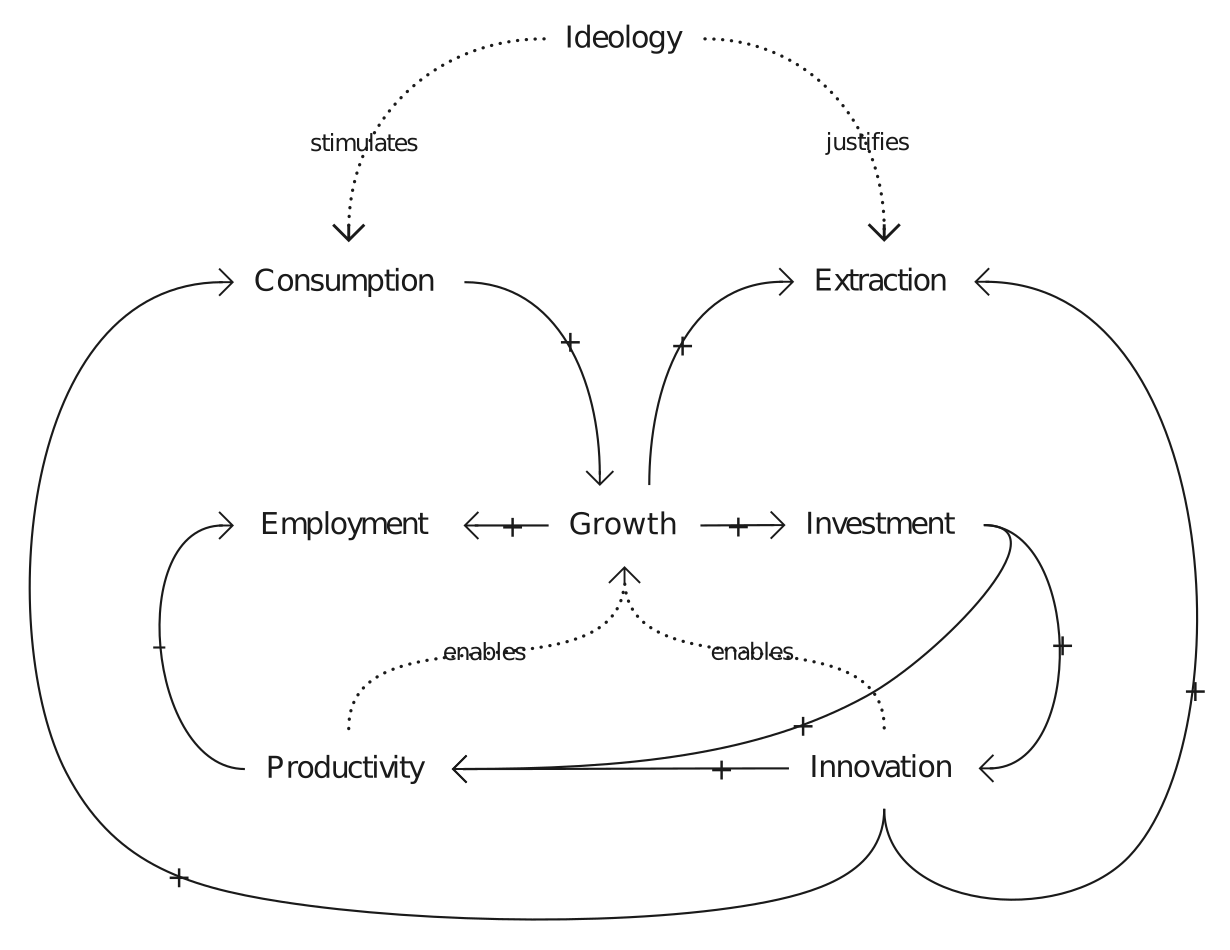
In our case, ideology bends individual behaviour towards
extraction and consumption. A growth- and innovation-based
system like ours uses these strategies in two interlocking feedback
loops:On the first feedback loop, see Harari (2014) and Lewis
& Maslin (2018); on the second, Jackson (2017).
growth enables investment, which increases innovation and
productivity, which enable further growth and reduce the need
for labour, which necessitates growth on pain of economic
collapse. Extraction provides the resources to feed these loops, while
consumption provides the demand to drive them.
Capitalism’s Growth Loops
And in fact, our civilisation has been so successful evolutionarily,
out-growing and displacing almost all other civilisations, because it is
the most extractive and the most innovative at the
same time: When resources are abundant, the most extractive culture will
be dominant, and innovation has made sure resources stay abundant.I will expand on this argument in a future essay.
Ideology can therefore be described on two levels:
On the level of the system, i.e. our civilisation,
extractive and consumerist ideology emerge from this evolutionary
process as implicit strategies that constrain the behaviour of
institutions, humans and other system components in the service of
maximising overall growth and thus dominance.
On the level of interactions between the components,
extractive and consumerist ideology are a cultural technē captured and
distorted by the interests of institutions, humans and other system
components that profit from its current configuration.
These descriptions lead to a very different conclusion than the
“we’re just too stupid” argument: We’re not too stupid to keep our
civilisation out of crisis, we’re too self-interested and blinded by
ideology, in the service of a growth-addicted, extractive wider system
that we create and that constrains us. We’re not missing cognitive
capabilities, but the space to unfold them without ideological
constraints.
What to Do
What we need to win this space is not more individual knowledge, but
the collective knowledge how to disrupt and transform ideology:
social technology to change our cultural technē. Three main
components of this social technology are critical theory, social
movements, and alternative institutions.This is similar how Erik Olin Wright describes the
tasks of emancipatory social science: “elaborating a systematic
diagnosis and critique of the world as it exists; envisioning viable
alternatives; and understanding the obstacles, possibilities, and
dilemmas of transformation” (Wright 2010, 10). Of course the latter two
need to be translated into strategic action.
Critical Theory
Critical theory is situated theory that supports the emancipatory
struggle of the (ideologically) oppressed from within a social movement.
As part of this endeavour and to help open a thinking space without (or
at least less) ideological constraints, it delivers a moral, epistemic
and ontological critique of ideology.
Critical theory enables the articulation, discussion and moral
assessment of problematic social relations previously masked by
ideology. It thus helps processes like consciousness
raising produce normative knowledgeHaslanger (2021), 56. Note her clarification on the
status of normative knowledge: “What I say here is compatible with a
robust moral realism, a quietist or deflationary moral realism, moral
constructivism, and some forms of moral anti-realism”.(Haslanger 2017,
165) For my own take on this, see “Is there such
a thing as moral truth?”
, which ideally leads to new or reformed norms around
these relations. Examples are the MeToo movement
and how it changed norms around acceptable male behaviour or, more
fundamental, the emergence of intersectional
feminism and how it reframed questions of social position.
In addition, “changes to the epistemic practices are required in
order to loosen the grip of ideology”Haslanger (2021), 55
. Part of this epistemic critique is emancipatory conceptual
engineering. It tries to wrangle concepts from ideology and give
them more useful meanings, e.g. by “debunk[ing] naturalistic accounts of
race and reveal[ing] race to be socially constructed”Haslanger (2018), 231
.
An ontological critique of ideology defends the reality of social
systems and structures against reductionism and methodological
individualism and provides a toolkit to expose ideological assumptions
and positsFor realist social ontologies see e.g. Haslanger (2019)
and DeLanda (2005). Cf. also my “From
Predictive Processing to Topological Thinking: Prolegomena to a Future
Paradigm”.
. Frameworks like the “implicit model as cultural technē”
one proposed here can bridge the gap between ontological and epistemic
critique.
A prerequisite for the practice of participatory critical theory are
spaces where the oppressed can articulate and examine their experiences
without the framing of the oppressing system, even in its well-meaning,
“supportive” guise. These spaces can only be created by social movements
and alternative institutions, which can in turn be supported and
legitimised by critical theory.
Examples for critical theory include Sally Haslanger’s conceptual
engineeringHer most influential work in this regard is probably
Haslanger (2000).
, Critical Race TheoryFor an overview see Delgado & Stefancic
(2001).
, Bonneuil & Fressoz’s account of the Anthropocene
discourseBonneuil & Fressoz (2016)
, and Mitchell & Chaudhury’s critique of white
apocalyptic thinkingMitchell & Chaudhury’s (2020)
.
Social Movements
Social movements are concerted efforts by large groups of people to
demand and promote social change. They “intervene in material
conditions”Haslanger (2018), 231
and try to effect the desired change by one or more of
three pathways:
Direct action to autonomously implement changes and/or
force specific actors and systems to change their behaviour
Mass action to change the environment of actors and
systems, i.e. their incentives, e.g. through material disruption or a
shift of public opinion
Symbolic action to create awareness, influence the
political agenda and shift the Overton Window
of what’s politically acceptable
All three pathways ideally lead to both direct and indirect results:
They make harmful or oppressive behaviours and strategies less
attractive or even untenable, promote alternatives to these behaviours,
and undermine the invisibility and legitimacy of the dominant
ideology.
Successful movements connect what people already care about with a
larger cause and enable them to experience self-determination
in a collective effort. This creates experiences of agency and choice
and thus sets the stage for changing social technē via critique and
alternative institutions.
The third component is “building alternative institutions and
deliberately fostering new forms of social relations that embody
emancipatory ideals”Wright (2010), 324
, thus changing our cultural technē and over time
civilisation itself.
There are three different pathways how such institutions can
fundamentally change the current system. Two of them work bottom-up in
an either revolutionary or evolutionary way:
first, by altering the conditions for eventual rupture, and second,
by gradually expanding the effective scope and depth of their operations
so that capitalist constraints cease to impose binding limits.ibid, 328
A third pathway involves “engaging the state, using it to further the
process of emancipatory social empowerment”ibid., 336
in a process of system transformation rather than
replacement.
Our civilisation is a complex system, and we can’t predict the
influence alternative institutions will have on it. Therefore either of
these approaches needs to start with experiments of limited scope that
can be scaled up if successful (which is exactly how proponents of
People’s Assemblies and Universal Basic Income are approaching the
issue).
All of these approaches also need to take into account that they are
competing not only with specific institutions, but through their
connections with and embeddedness in other social systems with a whole
set of arrangements (a global civilisation) that has successfully
displaced almost all alternatives because it is the most
extractive and the most innovative at the same time.
Short of global revolution or collapse, alternative institutions will
only be successful in such a competition if they can siphon resources
from the existing arrangements into experiments and exploit existing
institutions to scale the successful ones. They have to extract
resources from an extractive system to outcompete its components, which
can happen in one of two ways:
They can introduce effective resource constraints (without tipping
the global system into collapse) which change the selection criteria for
civilisations in favour of more resource-efficient ones; or they can
create new sources of abundance, e.g. through regenerative practices,
which enable them to outcompete the current regime under the same
selection criteria, but with different resources.
For simple thermodynamic reasons, a shift in energy sources or
material technologies will not suffice; there needs to be a fundamental
change in social technologies and, first and foremost, our
cultural technē. In essence, we need to find and adopt non-material
sources of abundance:
[O]n today’s evidence, technologizing our way out of this does not
look likely. […] [T]he only solution left to us is to change our
behavior, radically and globally, on every level. In short, we urgently
need to consume less. A lot less. And we need to conserve more. A lot
more. Emmott (2013), 184–186
What we therefore need are paradoxical memes: Ideologies and
institutions that can, promoted and prefigured by social movements,
outcompete extractive counterparts by opposing and reversing
extraction.
Emancipatory Social
Technology
If all three components – theory, movements, institutions – are
working and mutually reinforcing, we have the knowledge we need: a
working and resilient social technology to change our cultural
technē.
And we can finally start stepping out of the trap that is the
Anthropocene.
References
Arthur, W. B. (2009), The Nature of Technology: What It Is and
How It Evolves
Bailer-Jones, D. M. (2009), Scientific Models in Philosophy of
Science
Blitz, M. (2014), “Understanding Heidegger on Technology”, The
New Atlantis 41, 63–80
Bonneuil, C., Fressoz, J.-B. (2016), The Shock of the
Anthropocene: The Earth, History and Us
Clark, A. (2013), “Whatever next? Predictive brains, situated
agents, and the future of cognitive science”, Behavioral and Brain
Sciences, 36(3), 181–204
Conant, R. C., Ashby, W. R. (1970), “Every good regulator of a
system must be a model of that system”, Int. J. Systems Sci. 1,
89–97
Craik, K. J. W. (1943), The Nature of Explanation
DeLanda, M. (2005), A New Philosophy of Society: Assemblage
Theory and Social Complexity
Delgado, R., Stefancic, J. (2001), Critical Race Theory: An
Introduction
Emmott, S. (2013), Ten Billion
Friston, K. (2013), “Active inference and free energy”,
Behavioral and Brain Sciences 36(3), 212–213
Harari, Y. (2014), Sapiens
Haslanger, S. (2000), “Gender and Race: (What) Are They? (What) Do
We Want Them To Be?”, Noûs 34(1), 31–55
——— (2017), “Culture and Critique”, Aristotelian Society
Supplementary Volume xci, 149–173
——— (2018), “What is a Social Practice?”, Royal Institute of
Philosophy Supplement 82, 231–247
——— (2019), “Cognition as a Social Skill”, Australasian
Philosophical Review 3(1), 5–25
——— (2021), “Political Epistemology and Social Critique”, in: Sobel,
D., Vallentyne, P., Wall, S. (eds.), Oxford Studies in Political
Philosophy Volume 7, 23–65
Holland, J. H. (1995), Hidden Order: How Adaptation Builds
Complexity
Jackson, T. (2017), Prosperity without Growth
Juarrero, A. (1999), Dynamics in Action: Intentional Behavior as
a Complex System
Kirchhoff, A., et al. (2018), “The Markov blankets of life:
autonomy, active inference and the free energy principle”, J. R.
Soc. Interface 15, 20170792
Lewis, S. L., Maslin, M. A. (2018), The Human Planet
Meadows, D. H. (1999), “Leverage Points: Places to Intervene in a
System”, Sustainability Institute
Mitchell, A., Chaudhury, A. (2020), “Worlding beyond ‘the’ ‘end’ of
‘the world’: white apocalyptic visions and BIPOC futurisms”,
International Relations 34(3), 309–332
Polanyi, M. (1966), The Tacit Dimension
Pritchard, D. (2010), What is this Thing Called
Knowledge?
Ramstead, M. J. D., et al. (2019): “Multiscale integration: beyond
internalism and externalism”, Synthese 198, 41–70
Ryle, G. (1949), The Concept of Mind
Servigne, P., Stevens, R. (2020), How Everything Can
Collapse
Seth, A. K. (2015), “The Cybernetic Bayesian Brain: From
Interoceptive Inference to Sensorimotor Contingencies”, in: Metzinger
& Windt (eds), Open MIND 35(T)
——— (2021), Being You: A New Science of Consciousness
Steffen, W., et al. (2011), “The Anthropocene: From Global Change to
Planetary Stewardship”, Ambio 40, 739–761
Wright, E. O. (2010), Envisioning Real Utopias
Zagzebski, L. (1999), “What is Knowledge?”, in: Greco, J., Sosa, E.,
(eds), The Blackwell Guide to Epistemology
Acknowledgements
I am grateful to Harley McDonald-Eckersall, Gregor Groß and Phil
Harvey for comments on drafts of this essay.
]]>From Predictive Processing to Topological Thinking: Prolegomena to a Future Paradigm2022-01-07T00:00:00+00:002023-10-14T03:40:02+01:00http://localhost:4000/topological-thinkingThe heart of a scientific paradigmUnderstood as “accepted examples of actual scientific
practice – examples which include law, theory, application, and
instrumentation together – [that] provide models from which spring
particular coherent traditions of scientific research”. (Kuhn 1970,
10)
is a practice (“how understanding is being done”), its
foundation an ontology (“what there is to understand”). Any future
paradigm should reflect our best knowledge about how biological and
social systems actually understand the world instead of
phantasising about how understanding could or should work.
According to current researchSummarised, e.g., in Clark (2013) and Seth
(2021).
, understanding is generating, using and validating
predictive models of the world. A predictive model can be
implemented in various waysImportantly, it can be an implicit model,
i.e. a non-conceptual, embodied representation of a system’s
environment.
, depending on the system that has it: In bacteria, it is
implemented in hard-wired chemical reactions (“chemotaxis”); in
humans, it is a simulation running on our brain (“controlled
hallucination”Seth (2021), 17
); in civilisations, it is their cultural technēHaslanger (2019)
Conventional ontologies don’t reflect this emerging understanding of
understanding: They are based on our manifest image of the world“[T]he framework in terms of which man came to be aware
of himself as man-in-the-world” (Sellars 1963, 7). Sellars describes its
objects as follows: “Thus we are approaching an answer to the question,
‘what are the basic objects of the manifest image?’ when we say that it
includes persons, animals, lower forms of life and ‘merely material’
things, like rivers and stones.” (ibid., 9) See Ladyman & Ross
(2007, 3–5) for a thorough critique of ontologies derived from this
image.
, abstracting from it only to a certain degree – they
posit things, events or processes that exist in space and time and that
interact causally as we experience everyday things to interact in space
and time. But our manifest image is the product of our brains’
simulations and of social construction – it cannot claim to have
anything to say about what there really is to understand. Its
features are an explanandum, not an explanans. For a more reliable
starting point we must, again, look to science.
The best and most current physics tells us that space and time, and
a fortiori everything that we imagine to exist in space and
time (things, events, processes), cannot be fundamental to reality.Nima Arkani-Hamed makes a very convincing case for this
in his public lectures, e.g. in Arkani-Hamed (2017).
They emerge from something deeper, from what there
really is.
Thus an adequate ontology has to discard space and time (and with it
things, events and processes) and aim to describe this deeper reality.
To do so, we can start with the basic fact that there is difference in
the world – that “something can be distinguished from everything
else”Friston (2019), 4, who develops a formally rigorous
framework based on an (albeit implicit) ontology similar to the one
outlined here. The same point is made by René Thom (1975, 1): “Whatever
is the ultimate nature of reality […], it is indisputable that our
universe is not chaos. We perceive beings, objects, things to which we
give names. These beings or things are forms or structures endowed with
a degree of stability […].”
. We call such distinguishable somethings
systems: groups of interdependent items forming a coherent
whole, defined by their boundary, i.e. by what is and what is not part
of them. Each item that is part of a system can itself be understood as
a system. This means that our ontology will be about a hierarchy of
systems, up to the world as the system of all systems. And since we
want our ontology to be as parsimonious as possibleThere are long-running debates in academic philosophy
whether parsimony should be an unqualified optimisation target for
ontologies. I believe it should – if it is
combined with a simultaneous optimisation for productivity.
, it will be about nothing else.
Note that this ontology doesn’t privilege any single level of
description – there is no fundamental reality, no “true” system (apart
from the world as a whole). It’s systems all the way down – and up: An
elementary particle is just as real as a biological cell, a dog as real
as a family, a culture as the climate. What will be privileged
are parsimonious descriptions: accounts describing systems on the
informationally most efficient level. In this ontology, maximum
parsimony goes formidably well with maximum diversity of entities.This is very similar to Don Ross‘s “Rainforest Realism”
(Ross 2000), which is a realist interpretation of Daniel Dennett’s “real
patterns” (Dennett 1991), based on information-theoretic efficiency.
Another parallel is Hoel’s (2017) work on how higher-level causation
emerges from microphysical reality due to an increase in effective
information.
Now, since we have discarded space and time as not fundamental,
systems in this abstract and fundamental sense cannot be said to exist
in space and time. But how and where do they exist?
The most parsimonious way to think about this is to just assume what
our best models of systems assume. From physics to forecasting
our most advanced models are captured in some form of mathematics, so
they strictly only assume what they need to run their mathematics: a state spaceMore technically, we “infer just that fundamental
structure and ontology that is required by the dynamical laws” (North
2013, 188). An example for this is a Hilbert space in
which equations describe vectors or operators.
. Systems thus minimally exist as sets of states in a
state space. State spaces are topological spaces, or more precisely manifolds, of which
the states are the constituent points. So, extrapolating from what our
models need to work, what there really is are systems existing as
structures in topological spaces.
What we really want to understand are patterns of system behaviour.
How would such an ontology help us do that?
For any system, exhibiting patterns of behaviour just means tending
to be in certain states. These patterns thus form “basins
of attraction” in the system’s state space: topological structures
defined by its attractors, i.e. by
topological singularities that shape the topological space around them
and define possible state trajectories through it.See Abraham & Shaw (1992) for an excellent visual
and DeLanda (2002) for a very clear conceptual introduction to these
ideas.
As systems exist in exactly the states their attractors
define, we can say they are these attractor-defined topological
structures.Juarrero (1999, 156): “A system’s identity is captured
in the signature probability distribution of its dynamics.”
Understanding patterns of behaviour, then, is
topologically describing the defining attractors.This is what Manuel DeLanda calls topological
thinking, the term in the essay’s title. His explication of
Deleuze’s dynamical process ontology (DeLanda 2002) is based on ideas
similar to the ones outlined here. Topological thinking is being adopted
in a wide range of disciplines, albeit mostly without explicit
ontological reflection. See for example the shift towards geometric
descriptions in fundamental physics (from Hamiltonian
mechanics to the so-called amplituhedron and
“positive geometries”),
Joscha Bach’s automata-generated “global fractal”,
Karl Friston’s Free Energy
Principle and its vector gradients, the manifold
hypothesis in machine learning, attractor landscapes from
molecular biology and genetics to climate and earth system science, and
Dave Snowden’s “energy
gradients”.
With this, we have come full circle:
Topological structures are not only something very abstract and far
removed from our Manifest Image, but also something we can actually
imagine. Our brain has evolved to perceive the world to exist
in space and time (a fact that needs to be explained), and it can
construct topological structures as abstractions from space and time
that still retain a quasi-visual quality.
Thus we can use topology to describe highly abstract and complex
facts about the world in a very efficient and explicit, but even more
importantly concrete and tangible way. We can use our ontology to
generate not only less familiar, but also more accessible models.
So if we accept how we really understand things, understanding what
there really is means describing the world at a very high level of
abstraction in a very tangible way: describing systems in topological
terms.
This should be the practice at the heart of our next paradigm.Methods to be derived from this core practice could
range from mathematical modelling and visualisation techniques through
scale-free abstractions like Markov blankets, gradient flows and
self-organised criticality to de-familiarisation strategies and the
induction of psychosis-neighbouring states “at the edge of chaos” that
enhance pattern recognition. Possible containers for these practices
range from hard science through the facilitation of distributed
cognition to the arts and subcultural experimentation.
References
Abraham, R. H., Shaw, C. D. (1992): Dynamics: The Geometry of
Behavior
Clark, A. (2013), “Whatever next? Predictive brains, situated
agents, and the future of cognitive science”, Behavioral and Brain
Sciences, 36(3), 181-204
DeLanda, M. (2002), Intensive Science and Virtual
Philosophy
Dennett, D. C. (1991), “Real patterns”, Journal of
Philosophy 88(1), 27-51
Friston, K. (2019), “A free energy principle for a particular
physics”, arXiv:1906.10184
Haslanger, S. (2019), “Cognition as a Social Skill”,
Australasian Philosophical Review, 3(1), 5–25
Hoel, E. P. (2017), “When the Map Is Better Than the Territory”,
Entropy 19(5), 188
Juarrero, A. (1999), Dynamics in Action: Intentional Behavior as
a Complex System
Kuhn, T. S. (1970), The Structure of Scientific
Revolutions, 2nd edition
Ladyman, J., Ross, D. (2007), Everything Must Go
North, J. (2013): “The Structure of a Quantum World”, in: Ney, A.,
Albert, D. Z. (eds.), The Wave Function, 184–202
Ross, D. (2000), “Rainforest Realism”, in: Ross, D., Brook, A.,
Thompson, D. (eds.), Dennett’s Philosophy: A Comprehensive
Assessment, 147–168
Sellars, W. (1963), “Philosophy and the Scientific Image of Man”,
in: Science, Perception and Reality, 1–40
Seth, A. (2021), Being You: A New Science of
Consciousness
Thom, R. (1975), Structural Stability and Morphogenesis
(English translation)
Acknowledgements
I am grateful to Glenda Eyoang and Gregor Groß for comments on drafts
of this essay.
]]>Expressivism and Constructivism in Metaethics2021-12-08T00:00:00+00:002023-10-14T03:40:02+01:00http://localhost:4000/expressivism-constructivism-metaethicsFor decades, metaethical debates have been mainly about two
questions: How metaethical theories fit into a larger naturalistic
worldview, and how well they make sense of ordinary moral discourse.
Usually, metaethical theories have prioritised one desideratum at the
cost of the other, resulting in different theoretical challenges:
Moral realism, the view that moral judgements refer to objective
facts and are (at least sometimes) true, seems to make good sense of how
we usually think and talk about these judgements. But it has to account
for the fact that “if there were objective values, then they would be of
a very strange sort” and would have to be perceived “by some special
faculty of moral perception or intuition, utterly different from our
ordinary ways of knowing everything else” (Mackie 1979, 38). And it has
to explain how moral beliefs can motivate us to act – why they are, in
other words, not “motivationally inert” (Sayre-McCoord 2015, 11) like
nonmoral beliefs.
Moral anti-realism, on the other hand, denies one or both of moral
realism’s claims and thus sidesteps its challenges. But it has to
account for the purported objectivity of moral judgements – it should be
able, for example, to show that “it is not because of the way we form
sentiments that kicking dogs is wrong [but] wrong whatever we thought
about it” (Blackburn 1984, 217). And it needs to prove that it can
capture ordinary moral talk in a way that makes sense of its meaning and
structure, i.e. account for “the similarities between the semantic
function of ethical sentences and descriptive sentences” (Chrisman 2011,
38).
More recently, two metaethical views have claimed to do better than
either traditional realism or anti-realism: Expressivism and
constructivism both assert they don’t share the ontological,
epistemological and psychological vulnerabilities of realism, but
nonetheless avoid the objections of relativism and inaccurate
understanding of language usually mounted against anti-realism.
The relationship between the two views has been controversial
(Darwall et al. 1992, Gibbard 1999, Magri 2002, Korsgaard 2008, Chrisman
2010, Lenman 2012, Ridge 2012, Wallace 2012, Southwood 2018). The
positions on the issue have expanded over time, from diagnosing a clear
opposition (Darwall et al. 1992; see also Magri 2002, 153) to seeing
them as two expressions of essentially the same programme (Gibbard 1999,
Magri 2002) to arguing that constructivism as a metaethical doctrine
might collapse into expressivism (Ridge 2012, Southwood 2018).
I want to argue for yet another option: According to my proposal,
expressivism and constructivism are expressions of two fundamentally
different metaethical projects, and as a result, are neither
contradictory nor equivalent, but complementary. I will argue that while
expressivism aims to explain moral judgement from without,
constructivism articulates it from within moral discourse. This
reframing sheds new light on metaethical challenges, clarifies the
character and relationship of expressivism and constructivism, and
enables a reassessment of the traditional distinction of normative
ethical and metaethical theories. Connected to a broader context, it can
also help clarify the scope and broaden the horizon of metaethics to
become a more critical and relevant enterprise than it has been in the
past decades.
Expressivism
According to ethical expressivismWith “expressivism”, I refer exclusively to
expressivism about moral judgements (statements, utterances – see next
footnote), in contrast to expressivism about other areas of discourse,
e.g. logic or language in general, as advocated, amongst others, by
Brandom (1994 and 2000). Blackburn has also called this position
“projectivism” in the past (1984, 1993), although he has since,
following Gibbard, also switched to the label “expressivism” (Blackburn
1998, 77).
, moral judgements are not descriptions of facts but
expressions of conative, i.e. desire-like attitudes like
approval or planning. When I say “Kicking dogs is wrong”, expressivism
contends, I am not describing the fact or expressing the belief that
kicking dogs is wrong – I am not ascribing the property “wrong” to the
act of kicking dogs. What I am really doing is expressing my
disapproval of kicking dogs or expressing my plan not to
kick dogs.Here and in the following, I am repeatedly switching
between “I am expressing an attitude”, “a judgement expresses an
attitude”, and “a statement expresses an attitude”. These are shorthands
for the following structure: I make moral judgements, and I utter
statements that represent these judgements. If a judgement expresses an
attitude, then the representing statement gives linguistic expression to
this attitude. As the utterer of the statement and the maker of the
judgement, in a broader sense, I can also be said to be expressing the
attitude in making the judgement and in uttering the statement.
The idea that moral judgements don’t express beliefs, but
non-cognitive attitudes goes back to emotivism, the doctrine that moral
statements express emotions, advocated, amongst others, by Ayer
(1936). According to emotivism, saying “Kicking dogs is wrong” amounts
to little more than shouting “Boo!” (Darwall et al. 1992, 146) when
someone is kicking dogs – both express a strong negative emotion towards
kicking dogs but have no other cognitive content. This makes emotivism a
clear case of moral anti-realism – “Boo!” does not describe an objective
fact.
Emotivism has two definitive advantages over moral realism. First, it
doesn’t refer to any “queer” (Mackie 1979, 38) normative properties – it
offers an entirely naturalistic interpretation of moral language and
thought. Second, it explains why we are motivated to behave according to
our moral judgements – our emotions compel us to do so. This is
sometimes called the “Humean Theory of Motivation” (Smith 1987): Desire,
i.e. how we want the world to be, motivates us to act, while belief
supplies us with options for the necessary action, i.e. with a map of
how the world is.
Emotivism’s disadvantage is that by denying that moral judgements
express beliefs, it ignores the apparent structure of moral claims – the
fact that “ethical sentences function semantically very much like
descriptive sentences” (Chrisman 2011, 37). That this is a real issue is
highlighted by the so-called Frege-Geach Problem, which shows that
emotivism cannot consistently account for the meaning that moral
statements contribute to larger, composite statements.
Its structure can be outlined in the following way (Chrisman 2011,
38–40): If a moral statement is to have any meaning, its content has to
be stable over the contexts in which it is used. If the statement
“Kicking dogs is wrong” expresses a negative emotion towards kicking
dogs, then it needs to express this emotion everywhere it is used to
have a stable meaning.
Now imagine the statement to be part of an implication:
If kicking dogs is wrong, then making your brother kick the dog is
wrong.
One can consistently assert the implication without asserting the
antecedent, i.e. one can assert it while staying neutral about whether
kicking dogs is wrong. But that means that in the context of the
conditional, it is possible for our statement not to express a negative
emotion. In other words, the statement’s content can change between its
assertion and its occurrence, which means it doesn’t have a (stable)
meaning.
More generally speaking, the Frege-Geach problem shows a tension
between two different semantic frameworks: the “ideationalist” (Chrisman
2011, 44) semantics of moral statements, whose meaning is said to be
determined by the states of mind they express, and the traditional
propositional-compositional semantics of descriptive statements, whose
meanings we take to be determined by the propositions they express.
Modern expressivism, as advocated by Blackburn (1984, 1993, 1998) and
Gibbard (1990, 2003), can be understood as an attempt to solve this
problem. Their main innovation is to employ a deflationary or minimalist
theory of truth (Blackburn 1998, 77–83; Gibbard 2003, 180–184).
According to such a theory,
there is no more to claiming “It’s true that pain is bad” than to
claim that pain is bad; the fact that pain is bad just consists in
pain’s being bad; to believe that pain is bad is just to accept that it
is. Then it’s true that pain is bad and it’s a fact that pain is bad –
so long as, indeed, pain is bad. (Gibbard 2003, 182–183)
If we accept minimalism, we are licensed to treat moral claims as
truth-apt, just as any descriptive claim – and this means we can take
large parts of our ordinary moral discourse at face value.Blackburn emphasises that this is very different from
treating moral claims as if they could be true: “I do not say that we
can talk as if kicking dogs were wrong, when ‘really’ it isn’t wrong. I
say that it is wrong (so it is true that it is wrong, so it is really
true that it is wrong, so this is an example of a moral truth, so there
are moral truths).” (Blackburn 1998, 319)
Blackburn has termed this programme
quasi-realism (Blackburn 1984, 1993). It aims to explain “from
a basis that excludes normative facts and treats humanity as part of the
natural world […] why we would have normative concepts that act much as
normative realists proclaim” (Gibbard 2003, xii).
How does quasi-realism help avoid the Frege-Geach Problem? According
to minimalism, “Kicking dogs is wrong” expresses the proposition that
kicking dogs is wrong
just like ‘Grass is green’ expresses the proposition that grass is
green. They each contribute these propositions – deflationarily
construed – to the logically complex sentences in which they figure,
thus determining the semantic contents of those sentences as a function
of the semantic contents of their parts. (Chrisman 2011, 42–43)
This makes it seem like the quasi-realist expressivist can have their
cake and eat it. But there’s a catch – a problem that Dreier (2004) has
called “creeping minimalism”: The more features of our moral discourse
minimalism helps us recover, the less apparent it becomes what is
distinctive about this discourse when compared to its descriptive
counterpart. Minimalism “threatens to make irrealism indistinguishable
from realism” (Dreier 2004, 26) by treating sentences that should
express conative attitudes as expressing “ethical propositions”
(Blackburn 1998, 73). Expressivism is thus caught in the even deeper
tension between recovering as much of our ordinary moral discourse as
possible and maintaining that, on a deeper level, this discourse works
differently from what our realist intuitions might tell us (Chrisman
2011, 43).See Schroeder (2009) for more concrete challenges
resulting from this tension.
There are different approaches to resolving this tension. Gibbard
(2003) shows how descriptive and evaluative components of language are
combined in plans. This should explain our quasi-realist use of
propositions and how we express attitudes with them. As a “pure
expressivist” (Schroeder 2009, 258), he locates the descriptive
components outside of moral judgements proper. In contrast, hybrid
approaches situate them within moral judgements so that these “consist
in both an ordinary descriptive belief and a desire-like attitude”
(Schroeder 2013, 286).See again Schroeder (2009) for an overview.
This makes it hard to understand, though, how language
can be learned in the first place: a hybrid expressivist “will have to
convince us that language learning children do acquire the ability to
distinguish ethical bits of language from descriptive bits of language”
(Chrisman 2011, 46), even though they have the same surface structure.
Yet other proposals try to resolve the tension by either expanding the
ideationalist framework to cover descriptive statements as well, leading
to a kind of global expressivismThis kind of global expressivism is different from the
global expressivism of Brandom (1994 and 2000; cf. fn. 1), as that is
built on a fundamentally different semantic paradigm (but see Price 2010
for a proposal on how to combine them). I will explore possible
connections between Brandom’s inferentialist framework and the framework
proposed in this thesis further down;
Chrisman (2010 and 2011) and Street (2010, 377) suggest a similar
inferentialist approach.
(Schroeder 2008), or recasting ideationalist semantics in
fundamentally compositional terms (Schroeder 2013).
What all these approaches share, though, is the size and complexity
of the technical apparatus they command to deal with expressivism’s
fundamental tension. In other words, they all face significant
theoretical costs associated both with attempting to give a
non-circular ‘ideationalist’ or ‘psychologistic’ account of semantic
content and with capturing the logical continuities between
expressivistic language and matter-of-factual language. (Chrisman 2010,
344)
These costs become even more problematic because of the apparatuses’
role in an expressivist account of normativity: As metaphysical
naturalists, expressivists maintain that there are no normative
properties (Gibbard 2003, 32) and hence no objective normative facts to
which moral judgements could be responsible. As a result, they have no
direct account of normativity or metaethical moral epistemology (Lenman
2012, 222–224). Instead, they take an indirect approach,
looking at our moral practices and explaining how we “project”
(Blackburn 1984, 170) normative properties onto the world. Minimalism
about truth then licences talk about normativity. As this quasi-realist
approach relies on the technical apparatuses just outlined, their high
theoretical costs endanger expressivism’s ability to account for
normativity at all.
Constructivism
Expressivism’s shift of focus towards moral practices is mirrored in
constructivismWith “constructivism” I refer to constructivist
positions about moral discourse (judgements, concepts, values etc.), not
any other discourses. More specifically, I refer to positions that are
rooted in a Kantian understanding of moral judgements (see below),
i.e. what has been called Kantian constructivism in a wider sense (see
below on Humean vs Kantian constructivism in a narrower sense).
. According to constructivism, moral judgements are
“conclusions of practical reasoning” (Korsgaard 2008, 309) and, as such,
solutions to practical problems (Rawls 1980, 571–572; Korsgaard
2008, 321; Lenman 2012, 216). When I say, “Kicking dogs is wrong”, I am
therefore not describing the world but concluding my reasoning about how
to treat dogs. This conclusion can be restated as “One ought not to kick
dogs”, – which is (part of) my solution to the problem of how to treat
dogs.This is similar to how Gibbard describes his programme
of explaining oughts with plans: “If we understand concluding what to
do, then we understand concluding what a person ought to do.” (Gibbard
2003, x) See also how, based on this similarity, he assimilates the
constructivist programme to the expressivist one in Gibbard
(1999).
Constructivism’s status as a metaethical theory is controversial
(see, e.g., Darwall et al. 1992, Hussain & Shah 2006, Lenman 2012).
Part of the reason is that it has begun as a specific type of
substantive ethical theory, i.e. as normative theories about
particular domains. The most famous such theory is Rawls’s Theory of
Justice (Rawls 1971), in which he proposes a solution to the problem of
how to organise society fairly – his principles of justice. This
solution is arrived at using a process of construction, the hypothetical
decision-making process of rational individuals in an original
position.Rawls has restated this argument in a genuinely
constructivist form and introduced the label of Kantian constructivism
in Rawls (1980). Another example of a substantive constructivist theory
is Scanlon’s account of what is morally right, which he conceptualises
as “what could be justified to others on grounds that they, if
appropriately motivated, could not reasonably reject” (Scanlon 1998,
5).
The process moves from justice, a general concept that “refers to
whatever solves the problem”, to a specific conception that “proposes a
particular solution” (Korsgaard 2008, 322) – Rawls’s two principles of
justice. According to constructivism, this is precisely the task of
practical philosophy: “to move from concepts to conceptions, by
constructing an account of the problem reflected in the concept that
will point the way to a conception that solves the problem.” (ibid.)
As a normative theory about a specific domain, Rawls’s Theory of
Justice is a “restricted” constructivist view (Street 2010, 367) – it
aims “to give an account of the truth of some limited subset of
normative claims” (ibid., 368), not of all normative claims.
This also means it relies on other normative judgements as inputs to its
process of construction without justifying them – “certain normative
judgments implicit in the public political culture of a liberal
democratic society” (ibid.).Ignoring that these assumptions are explicitly
normative has been one of the key misunderstandings of Rawls’s work,
which has led him to make the restricted scope of his theory as one of
“Political Liberalism” much clearer in his later work (Rawls
1993).
From a constructivist perspective, this restriction is what
distinguishes a substantive ethical from a metaethical theory:
Where the former deals with the truth of specific normative claims, the
latter gives “an account of what it is for any normative claim to be
true” (ibid., 369).Street therefore also calls this version “thoroughgoing
constructivism”. (Street 2010, 369)
Metaethical constructivism aims to provide a process of
construction that is common to all moral judgements, regardless of their
domain. It generalises the central “metaethical insight” (ibid.) of
constructivism: that a process of construction can set “standards of
correctness in the normative domain” and thus guarantee a kind of
objectivity that obviates the need for “an ‘independent order’ that
holds apart from the attitudes of valuing creatures” (ibid.). This way,
the metaethical constructivist is licensed to talk about moral facts,
understood as “complex facts about the solutions to practical problems
faced by self-conscious rational beings” (Korsgaard 2008, 325).
Street distinguishes between two versions of metaethical
constructivism: A Kantian view, on which some substantive
normative truths follow from the standards of correctness themselves,
and a Humean one, on which substantive normative truths still
depend on normative inputs – the “particular set of values with which
one finds oneself alive as an agent” (ibid., 370).In an earlier paper, Street calls the two versions
“substantive” and “formalist” constructivism (Street 2008, 243). While
potentially confusing in their relationship to the concepts of
restricted and metaethical constructivism, these labels avoid obscuring
the Kantian foundations of Humean constructivism (see below).
Examples of the former view are Kant’s moral philosophy,
which claims to derive the Categorical Imperative from the nature of
practical reason, and Korsgaard’s brand of constructivism which claims
that the reflective structure of human consciousness entails that
“enlightenment morality is true” (Korsgaard 1996b, 123). An example of
the latter is Street’s own project, in which she aims to vindicate “the
objectivity of ethics […] without metaphysical and epistemological
mystery” by showing “that there is a universal problem, faced by every
individual agent, to which morality is the universal and best (or only)
solution” (Street 2016b, 166).
Even in its Humean version, constructivism’s answer to the challenge
of motivation is deeply Kantian: It’s not desire that motivates us to
act in accordance with our moral judgements (like in a Humean theory of
motivation), but the fact that these judgements are the conclusions of
practical reasoning. According to the constructivist, you need no
additional motivation to do something you have reason to do (Scanlon
1998, 33): “Normative judgments are […] are by their nature motivating,
such that if one judges that one has reason to Y, then one is thereby
necessarily at least somewhat motivated to Y.” (Street 2008, 230).
But we are not only motivated to do something if we have reason to do
it – we also should do it. This leads to the further question
of why moral judgements are binding, i.e. the source of their
normativity (Korsgaard 1996a). Metaethical constructivism doesn’t derive
the normative force of moral judgements from other, already accepted
moral judgements like restricted constructivisms. Their normative force
can thus only originate in the process of construction itself. But how
can this process be a source of normativity? How is it justified itself?
One possible answer that doesn’t “make constructivism collapse into one
or other of the standard metaethical views” (Southwood 2018, 363) is a
transcendental interpretation of the process. On this view, the process
of construction is “constitutive of the attitude of valuing or normative
judgement” (Street 2010, 374); it is part of “what a creature must be
doing to count as a valuer at all” (ibid., 369). Thus “considerations
become normative for us through the commitments that are constitutive of
agency” (Wallace 2012, 27–28).
That a specific process of construction should be constitutive of
valuing in general seems far-fetched. But this is a problem of
the “proceduralist characterisation” (ibid., 364) of constructivism we
have used so far, not of constructivism itself. As Street argues,
the notion of procedure is ultimately merely a heuristic device,
whereas the philosophical heart of the position is the notion of the
practical point of view and what does or doesn’t follow from within it.
In Rawls’s theory, for example, the original position is ultimately best
understood as a heuristic device whose function is to capture, organise,
and help us to investigate what follows from a certain evaluative
standpoint on the world – in particular, the evaluative standpoint
shared by those of us who accept liberal democratic values such as the
freedom and equality of persons. (ibid., 366)
Hence a more helpful characterisation of constructivism states that
moral claims are true if they are “entailed from within the practical
point of view” (ibid., 367) of a moral agent. Street calls this the
“practical standpoint characterisation” (ibid., 366) of constructivism.
Restricted constructivisms specify the practical standpoint in a
material way as “the standpoint of one who accepts […] some
further set of substantive normative claims” (ibid., 368). Metaethical
constructivism, on the other hand, gives a purely formal
specification of the standpoint – it “merely explicates what is involved
in valuing anything at all” (ibid., 369).
This, then, is the constructive challenge for the metaethical
constructivist – to provide an explication of the evaluative standpoint
that fulfils two competing requirements: On the one hand, it has to be
rich enough to generate meaningful standards of correctness that account
for errors of moral judgement and avoid that “normative thought becomes
peculiarly self-validating” (Wallace 2012, 36), or so-called
“bootstrapping” (ibid., 28). On the other, it must be thin enough to
accommodate the fact that a valuer can “value virtually anything at all”
(Street 2010, 369).Street warns about the dangers of conceptions that are
too thick: “Constructivism’s supporters face, and too often give in to,
a constant temptation to build too much into their account of what is
constitutively involved in the attitude of valuing. The hope of getting
morality ‘out’ lures people into packing implausibly much ‘in’, and the
resulting account of ‘pure’ practical reason ends up not in fact pure.”
(Street 2010, 382)
Whatever the constructivist may identify as constitutive of valuing,
though, the answer will be a “high-level claim about the truth-makers of
normative assertions” (Wallace 2012, 23). In other words,
“constructivist theories are making claims about truths about reasons
(i.e. about the world), as opposed to claims about the concept of a
reason (i.e. about meaning)” (Southwood 2018, 344). This is a
significant difference from expressivism, which is almost exclusively
occupied with questions of meaning. And it is the other reason why
constructivism’s status as a metaethical theory is contentious (Hussain
& Shah 2006, Lenman 2012, Hussain & Shah 2013): In the end, it
seems to be a (very general) way of talking about which moral judgements
we have reasons to accept – about substantive questions, not metaethical
ones (Wallace 2012, 24).
Perspectives
From these reconstructions, it should be clear that expressivism and
constructivism share a focus on practice (Magri 2002, 153) – they both
start from the insight that “even if we aren’t sure what value is, we do
understand the attitude of valuing” (Street 2010, 366). They are also
both opposed to traditional moral realism and the interpretation of
moral language as descriptive (Wallace 2012, 20). But apart from that,
they have very different strengths, and they struggle with almost
diametrically opposed challenges.
Expressivist theories were “developed largely to explain the
significance of normative judgments for the agent who makes them – to
explain how such judgments ‘motivate’ an agent” (Scanlon 2014, 58). They
focus on the causal, i.e. “regular connection between one’s
ethical judgements and one’s motivation to act in light of them”
(Chrisman 2010, 333). This explains why they are strong at giving
naturalistic explanations of the attitude of valuing.
But it also means they treat normative judgements “as bits of
deliberative phenomenology that are to be explained theoretically, but
not really taken seriously in their own right” (Wallace 2012, 32).Here and in the following quotes, “deliberation may be
understood as reflection that aims to resolve the question of what one
should think or do” (Wallace 2012, 19), i.e. to solve a practical
problem.
To capture reasons, i.e. the “apparently
rational connection between ethical judgements and actions”
(Chrisman 2010, 333), expressivist theories rely on minimalism about
truth, which allows them to reconstruct normativity indirectly. But as
we have seen, minimalism comes with high theoretical costs in the form
of large apparatuses for understanding language. As a result,
expressivist theories struggle to “capture the normative grip” (Scanlon
2014, 58) of moral judgements.
Constructivism, on the other hand, is strong in capturing this grip
(Wallace 2012, 25–26) by deriving it from commitments constitutive of
our agency. As a consequence, constructivist theories don’t have to rely
on a specific account of language (Street 2010, 376–377) – they can
“endorse a standard account of the meaning of ethical sentences in terms
of their truth-conditions” (Chrisman 2010, 344).
However, focusing on these truth-conditions calls into question
constructivism’s metaethical character. As we have seen, identifying
them is a substantive issue. Expressivists emphatically agree to this –
they see claims about the truth-makers of moral judgements as “internal
to normative thinking – though arrayed in sumptuous rhetoric” (Gibbard
2003, 186; see also Blackburn 1984, 217–219; Magri 2002, 157; Street
2011, 7–9). And they insist that if constructivism goes on to neglect
traditional metaethical questions of meaning and subscribes to the same
naturalistic metaphysics as expressivism, then there’s nothing left to
distinguish it from other metaethical views (Lenman 2012, Hussain &
Shah 2013).
So expressivism delivers on naturalistic metaphysics and fails to
complement it with a robust understanding of normativity, while
constructivism offers the latter but falls short on the former. Lenman
(2012, 224) and Wallace (2012, 25) argue that this is because the two
views answer different questions about moral discourse, making them
complementary rather than competitors. I think they are correct, but
their diagnosis can be given a firmer foundation by making explicit why
the different questions are being asked in the first place: because we
are concerned either, as observers of moral discourse, with the
explanation of moral practices or, as participants, with their
articulation. This means expressivism and constructivism are
not only different (and differently oriented) theories but
expressions of different philosophical projects.
To flesh out this idea, we can introduce “the contrast between
‘first-person’ and ‘third-person’ [as] the contrast between engaged
participant and disengaged observer” (Hussain & Shah 2013, 99). The
questions are thus asked from different perspectives:
The question how we explain moral behaviour is a third-person,
theoretical question, a question about why a certain species of
intelligent animals behaves in a certain way. The normative question is
a first-person question that arises for the moral agent who must
actually do what morality says. (Korsgaard 1996a, 16)These perspectives correspond to the practical and
theoretical standpoints of moral agents found in Kant and used by
Korsgaard and Street in their characterisations of constructivism: “When
we look at our actions from the theoretical standpoint our concern is
with their explanation and prediction. When we view them from the
practical standpoint our concern is with their justification and
choice.” (Korsgaard 1996b, 377–378)
The two perspectives are inescapable for us (Street 2016a, 294): We
always take a third-person perspective on the world – we always explain
and predict natural phenomena. This is how we as biological systems
survive in the world. But we also always take a first-person perspective
– we deliberate, we plan, we give and ask for reasons. This is not only
a phenomenological fact but can be given a transcendental
interpretation: By arguing about questions like this, we always assume
that there are reasons, that answers can be justified, that there is
normativity.Habermas (2007) makes the same point by saying that “we
are incapable of getting around the interlocking perspectives rooted in
our cultural forms of communication […]: we cannot abandon the
participant perspective, for ‘there is no observation without at least
virtual participation’.” (Habermas 2007, 37)
Ontologically speaking, what we articulate from a first-person
perspective (norms, reasons, obligations) supervenes on what we
describe from a third-person one (attitudes, desires, beliefs): Two
situations can differ in how they are judged morally only if they also
differ in how they are described or explained, in their “prosaically
factual properties” (Gibbard 2003, 90). Whichever perspective we’re
taking, we ultimately refer to the same reality, just looked at from
different perspectives. This makes sure naturalism isn’t violated.
How, then, do expressivism and constructivism relate to these two
perspectives? On the level of concrete moral judgements, they agree
about the perspectives’ role: What are merely expressions of attitudes
from a third-person perspective take on normative significance from a
first-person perspective (Wallace 2012, 20; Korsgaard 2008, 325;
Blackburn 1998, 51–59).
On the level of metaethical theory, however, they have very different
relationships to the two perspectives. Expressivism agrees that
attitudes have normative force from a first-person perspective. But as
we have seen, it “consists in a pattern of explanation” that “starts
with a state of mind” that can “be characterised naturalistically”
(Gibbard 2003, 194–195; see also Blackburn 1998, 49–50).This self-description closely mirrors Street’s
description of the theoretical standpoint: “When we occupy this point of
view on ourselves and our values, we understand ourselves as beings who
are part of the world of cause and effect, and whose normative judgments
are subject to causal explanation.” (Street 2016a, 294)
Thus it aims to explain this fact theoretically – from a
third-person perspective. This means expressivists look at moral
discourse as a whole from a third-person perspective – their view
“describes moral language from the outside, as if we were not
ourselves the creatures who face practical problems, but only someone
else making anthropological observations about them” (Korsgaard 2008,
325, my emphasis).
This also explains, on a structural level, why expressivism struggles
to give a robust account of normativity. As we move away from the
concrete moral judgement as seen from the first-person perspective,
expressivism adopts a perspective that makes normativity invisible:
When we step back from the normative commitments that are
constitutive of [the practical] standpoint, and ask whether those
commitments do or do not correspond to putatively objective normative
facts, then normativity seems to disappear from the scene. (Wallace
2012, 31)
Metaethical constructivists, on the other hand, take the first-person
perspective tout court. They give a general account of what
makes moral judgements true, which is, as we have seen, a first-order
question. Since, as moral agents, we ask and answer first-order moral
questions from a first-person perspective, we also ask and answer this
general question from a first-person perspective. So in a sense,
constructivism is making its claims within deliberation, not
offering “a theory about such deliberation” (Wallace 2012, 24).My reconstruction is markedly different from Wallace’s
and Street’s own view. Wallace argues for understanding constructivism
as a “theory about such deliberation” that offers an explanatory account
of it (Wallace 2012, 24). Street likewise claims that constructivism’s
“task of saying what is constitutive of the attitude of valuing or
normative judgment is an exercise in descriptive philosophical analysis
as opposed to a substantive normative one” (Street 2010, 374). My
reconstruction is closer to the alternative view Street adopts for the
sake of argument elsewhere: that “the traditional metaethical project of
reconciling normative discourse with a naturalistic worldview turns out
to be a substantive normative one” (ibid., 380). I will answer
objections against my reconstruction in section 5 and argue in how far
it is theoretically beneficial in section 6.
This means constructivist theorising doesn’t focus on explaining
metaethical issues about our moral practices from a third-person
perspective but on articulating these practices from within the
first-person perspective: uncovering, from within the practical
standpoint, the principles that constitute this standpoint and the
criteria we use to assess moral judgements.This understanding of articulation is similar to
Brandom’s idea of articulation as making explicit the, in his case
inferential, structure of a domain, in his case thought and language
(Brandom 1994 and 2000). It also resembles Lenman’s “model of
self-understanding” of moral inquiry (Lenman 2007).
These principles and criteria range from domain-specific
(restricted constructivisms) to general (metaethical constructivism).
Understanding this as a practical, first-person task means accepting
that articulation will always involve normative judgements – it is not
purely descriptive. Constructivism is not only practical but also
normative “all the way down”.
So in the proposed framework, constructivism articulates our
moral practices from a first-person perspective, while
expressivism explains them from a third-person
perspective. Notably, the two projects are not only complementary but
inherently so: If both perspectives are inescapable for us as rational
and moral agents, then any complete account of moral judgements must
include both – a theoretical explanation of valuing as well as a
conceptual articulation of it. Both expressivism and constructivism are
right in their own way, but only taken together do they give a full
account of moral judgements.
Objections
This proposal is open to two immediate objections. The first is about
expressivism’s relationship to the first-person perspective: If
expressivism acknowledges the normative force of attitudes when seen
from this perspective, doesn’t that mean it implicitly includes an
articulation of our practices from it as well? Blackburn indeed proposes
an account of the “pervasiveness of normativity” that looks quite
similar, outlining a “process of rationalisation” from within a “network
of normative considerations” (Blackburn 1998, 53–54). He then contrasts
this account with a “functionalist” one that “defuses” the pervasiveness
of normativity by offering third-person explanations of the normative
considerations (ibid., 58).
The relationship between these accounts can only be understood in one
of two ways: Either the normative account is part of expressivism’s
naturalistic “pattern of explanation” or external to it. In the former
case, normative considerations are merely epiphenomenal because they
“are located not by their place in a causal structure, but by their
place in a rational structure” (ibid., 53) and thus have no causal
efficacy. Blackburn seems to adopt this option, as he acknowledges an
“assimilation of the normative and the causal order” (ibid., 58).
Expressivism thus doesn’t offer articulation in addition to explanation
– it again treats the normative as something “to be explained
theoretically, but not really taken seriously in [its] own right”
(Wallace 2012, 32).Gibbard discusses the fact that first-person and
third-person aspects can be intertwined, without coming to a conclusion
on how to deal with it theoretically: “We can say in naturalistic terms
what planning consists in, but to conceive planning as planning is,
among other things, to plan. Conceiving ourselves as thinkers and
planners, then, intertwines naturalistic belief and plan. What plans of
mine are involved in thinking of you as a thinker and planner? I don’t
have a story along these lines worked out, and I’m quite unsure whether
any such story will turn out to be cogent.” (Gibbard 2003, 194)
In the latter case, the result is pretty much the
framework presented here – not the integration of a first-person
perspective into expressivism, but the addition of an orthogonal second
account.For more on such a combination of orthogonal accounts,
see the sections below.
The second objection asks the reverse question: Constructivism is
(supposed to be) a metaethical theory, so doesn’t it also take a
third-person perspective on the world (Wallace 2012, 24–25)? As we have
seen, constructivists and expressivists agree that constructivism
answers questions about the truth-makers of moral judgements and thus
engages in first-order ethics. Therefore it is committed to the
first-person perspective. The question, then, is whether constructivism
is doing anything beyond that, for which it needs to take a third-person
perspective. I can see three reasons for claiming it does – but all
three have already been answered or can be denied within the proposed
framework.
First, one might require constructivism to account for the source of
the normativity it ascribes to moral judgements, i.e. the attitude of
valuing. Why do these judgements give us reasons to act in a certain way
– why should they obligate us? This question is why, for example, Magri
(2002) and Wallace (2012) argue that constructivism needs to go beyond
first-order ethics and take an explanatory third-person perspective. It
has already been answered, though, by the transcendental argument that
normativity is “constitutive of the attitude of valuing or normative
judgement” (Street 2010, 374). This is very much in line with
constructivism articulating the attitude of valuing from the
first-person perspective, which can be seen by restating the
constitution thesis in the following way:
The normative force of the conception is established in this way: if
you recognise the problem to be real, to be yours, to be one you have to
solve, and the solution to be the only or the best one, then the
solution is binding upon you. (Korsgaard 2008, 322)
Second, one could probe deeper and ask, as do Hussain & Shah
(2006), what the attitude of valuing consists in exactly, again inviting
the switch to a third-person perspective for an answer. But once more,
the question has already been answered: Constructivism defines valuing
as solving practical problems that moral agents are confronted with
(Korsgaard 2008, 321; Lenman 2012, 216; Street 2016b, 166–174), thus
attaching it firmly to the first-person perspective. And it does so
through articulation, not explanation: If we take seriously that “for
the constructivist practical philosophy is a practical subject. Its
business is to work out solutions to practical problems” (Korsgaard
2008, 325), then the question of understanding the attitude of valuing
is also a practical problem, and as such answered from the first-person
perspective.Wallace gives the following example of a metaethical
question posed from the first-person perspective: “Skeptical questions
[…], including the question about the authority of basic normative
requirements, are posed from the perspective of deliberative agency.”
(Wallace 2012, 27)
This leads directly to the third and most far-reaching question,
which is whether constructivism counts as a distinct metaethical theory
at all if it effectively doesn’t go beyond solving practical problems,
i.e. first-order ethics. This is the central question of, for example,
Hussain & Shah (2006 and 2013) and Lenman (2012). As
constructivists, Korsgaard (2008) and Street (2010) answer that it is
not a real question because “the distinction between substantive
normative ethics and metaethics breaks down” (Street 2010, 363) when we
understand that ethics is “moral practice, all the way down” (Magri
2002, 160).
This is, of course, highly contentious. But it becomes a lot less so
once we reframe the constructivists’ point within the current framework:
If constructivism is about articulating our moral practices from within
the practical standpoint, then it should be practical “all the
way down”. Reflection is part of what Lenman (2007) calls “moral
inquiry”, from scrutinising particular judgements to examining the very
conditions of judging. Other theories, particularly expressivism, can
complement this from a theoretical standpoint. In the resulting picture
of metaethics, the distinction between looking at ethics from a
first-person and a third-person perspective supplants the traditional
demarcation between metaethics and normative ethics.
Benefits
If we are to prefer the proposed framework to any single metaethical
theory, it needs to deal at least as well as they do with our
metaethical challenges. Does it?
First of all, it fits nicely into a naturalistic worldview. The
first-person perspective doesn’t encompass or generate any properties
that aren’t supervenient on natural properties – it just offers
different concepts for some (combinations) of them, thus expanding what
Gibbard claims for expressivism: “a normative and a naturalistic concept
might signify the very same property” (Gibbard 2006, 323). Of course, we
need a positive theory to flesh out how the first-person perspective is
explainable on a third-person account and how the rational structure of
third-person accounts can be articulated from a first-person
perspective. The obvious candidate for the former is the evolution of
the self, an account endorsed by expressivist and constructivists alike
(e.g. Gibbard 1990, Street 2011). An inferentialist semantics can
prepare the ground for the latter.
Such a semantics can also be part of an account of moral language.
Instead of trying to explain normativity, a first-person phenomenon,
from a third-person perspective, we can now provide an account in two
parts: an empirical explanation of actual language use based on
psychological attitudes, and a normative articulation of the “rules of
the game”, starting with the rules of inference constitutive for
practical reasoning, taking them as the building blocks of an
inferentialist semantics (Chrisman 2010, 347–349; Street 2010,
377).See Brandom (1994 and 2000) as an example of such a
semantics. Cf. also fn. 6 and the next section.
This normative articulation also accounts for the objectivity of
moral judgements. By articulating the rational connections between
judgements and action from a first-person perspective, it uncovers
correctness criteria that we implicitly always use since they are
constitutive of the first-person perspective. From a third-person
perspective, these connections show up as empirical regularities
(cf. Chrisman 2010, 332–333, Blackburn 51–59).
These rational connections are part of the framework’s story about
motivation, too: From a first-person perspective, motivation to act is
articulated through reasons with normative force (cf. Scanlon 1998,
33–36). From the third-person perspective, it is explained causally by
referring to certain psychological states, e.g. the desires of moral
agents (Smith 1987).
Thus the minimum requirement is satisfied – the framework can provide
more complete answers than either constructivism or expressivism do on
their own. But there are also more specific theoretical benefits: By
reframing expressivism as being concerned with the explanation of moral
practices from a third-person perspective, and by explicating
normativity as an artefact of the first-person perspective, we can get
rid of expressivism’s chronic issues around normativity: If we accept
that normativity is a property that can only be attributed to attitudes
from a first-person perspective, expressivism as a third-person account
is relieved from having to explain it.
Furthermore, reframing helps us understand constructivism’s peculiar
character. Constructivism straddles the line between metaethics and
normative ethics, with worries that it might not be a metaethical theory
at all. We can now avoid this question altogether (and with it forcing
constructivism into unsuitable categories) by replacing the demarcation
between metaethics and normative ethics with the more fruitful
distinction between looking at normative ethics from a first-person and
from a third-person perspective.
Connections
Beyond ethics, this distinction resonates strongly with Sellars’s
famous metaphor of the two images (Sellars 1962). Sellars contrasts the
“manifest image of man-in-the-world”, our self-understanding as persons,
i.e. rational and moral agents giving and asking for reasons, with the
“scientific image”, which shows us as biological and physical systems
governed by causality. In the terminology of the framework developed
here, the manifest image is seen from the first-person perspective, the
scientific image from a third-person one.
Sellars himself took the images as complementary and, going further,
strove for what he called their “fusion” – an account of how we could
“explain our own human nature naturalistically without ‘explaining it
away’ altogether” (O’Shea 2007, 3). Such a fusion would provide a
third-person explanation of how the first-person perspective comes into
the world, i.e. how normativity and rationality evolve, and a
first-person articulation of these explanations’ rational and normative
structure. Though disconnected from Sellars’s original vision of a
fusion, classic candidates of the former are the evolutionary accounts
developed by “right-wing Sellersians” like Dennett and Millikan
(cf. Brandom 2010, 298).Those tend to treat the normative as an epiphenomenon,
though (cf. above). Ismael (2016) develops an equally naturalist, yet
less reductionist account.
The latter has been developed by “left-wing Sellersians”
like McDowell and, particularly systematically and most relevant to our
inquiry, Brandom (1994, 2000).Close to these views is Habermas (2007) who advocates
an “epistemic dualism of participant and observer perspectives” (ibid.,
13) which tracks the picture developed here very closely. While he
acknowledges that a fully naturalistic explanation of our human nature
might be possible, he maintains that “there is no ‘view from nowhere’–
no observation independent of prior participation in some kind of
communication” (ibid. 41). Thus, Habermas emphasises, philosophical
inquiry must always include a critical examination of our first-person
perspective and how it informs our third-person observations.
To understand how Brandom’s theory connects to the framework
developed here, we need another influential concept coined by Sellars:
the “logical space of reasons” (Sellars 1956), the normative space in
which we give and ask for reasons, which is contrasted to the physical
space of causes. (The space of reasons can, of course, be thought of as
accessible only from the first-person perspective, while third-person
descriptions and explanations illuminate the space of causes.)
Brandom (1994, 2000) articulates the space of reasons as a social
space. According to this articulation, sociality is a condition for
normativity: Our obligations are realised as commitments we attribute
and acknowledge in interpersonal I-Thou relations that structure the
social space of reasons. Therefore “the normative and the social are
interdependent, such that normativity can only be understood in terms of
participation in a social practice” (Weiss & Wanderer 2010, 4). This
mirrors and transforms how constructivism understands moral practices as
exercised within the practical standpoint: Just as the practical
standpoint is constituted by norms of correctness, for Brandom, “the
norms that govern thought and discussion […] are implicit in discursive
practice” (Gibbard 2010, 17). In a distinctly Hegelian move, Brandom
turns a transcendentally into a socially constituted standpoint.
It’s not much of a stretch to read Brandom’s account as the
explication of a “plural first-person perspective” (Korsgaard 2003, 55),
the perspective of a community engaged in the construction of morality.
It is realised by agents holding certain attitudes: “Normative statuses,
such as being committed, are only intelligible in a context that
includes normative attitudes such as acknowledging or attributing
commitments” (Brandom 2010, 298). These attitudes, their causes and
effects can, of course, also be described and explained from a
third-person perspective (ibid.), e.g. by evolutionary, historical and
critical accounts. This means we can use the social space of reasons as
a device to recast constructivism while making sure it is still
complementary with third-person accounts.
Framing and connecting Brandom’s work in this way serves three
critical functions for the framework developed here: First, the social
nature it ascribes to normativity defuses any reservations left about
constructivism’s capacity to deal with the bootstrapping objection.
Second, and more importantly, it provides a blueprint for how an
inferentialist semantics can contribute to the understanding of language
needed to meet our metaethical challenges. And finally, by following
Brandom’s Hegelian move, we can interpret moral truths as socially
constructed out of commitments and entitlements we attribute and
acknowledge in a social space of reasons. This gives a clear shape to
what could be called “Hegelian constructivism” – a constructivism that
grounds practical reasoning in social practices.
Conclusions
Hegelian constructivism could be part of a deflationary approach
to metaethics that further develops the ideas of the framework
presented here.
Such an approach would start with recognising that substantive,
first-order claims are what is really interesting about ethics and that
everything else should support their discussion. This mirrors
Koorsgaard’s contention that we need to “break with the platitudes of
twentieth-century ethics – and return to the more substantive ethical
theorising of the past” (Korsgaard 2008, 322).
This focus helps us recast metaethics’ jobs in terms of the success
criteria laid out at the beginning of this thesis: On the one hand,
metaethics should explain (from a third-person perspective) what we as
physical, biological and social systems do when we make moral
judgements. If we follow Sellars and take science as our best guide to
what is really happening in the world, then this is best done by a fully
naturalised metaethics (Prinz 2015). Expressivism thus becomes an
empirical hypothesis that can be experimentally tested. This part of the
approach is deflationary because it says that making moral judgements
just is what we are actually, physically and psychologically doing when
we assume we are making moral judgements.
On the other hand, metaethics should articulate (from a first-person
perspective) how we as moral agents give and ask for reasons when we
make moral judgements. If we follow Brandom and acknowledge that
normativity is essentially social, this is best captured by what I have
called Hegelian constructivism: the view that we construct moral
judgements out of commitments and entitlements we attribute and
acknowledge in a social space of reasons – which is importantly concrete
and historical.This goes beyond Brandom’s abstract conception of the
space; an example for such an extension is Kukla & Lance (2010).
Haslanger (2020 and 2021) gives an account of social practices that
could also inform a historicisation of the space of reasons, as could
Manne’s (2013) “intersubjective” metaethics.
This part of the approach is also deflationary because it
says that making moral judgements just is what we are actually doing as
participants in a game of giving and asking for reasons.
The two perspectives can be fused together by positive theories that
show how ethics as a social and normative system has evolved to serve
the cooperation needs of humans in a society (Gibbard 1990, 190) and how
our first-person perspective has evolved as the vantage point from which
a system navigates its environment, including the social and normative
systems we are part of or participate in.Greene (2013) provides a theory for the former, Ismael
(2016) for the latter question.
From these theories, moral discourse will emerge as part
of our “cognitive niche” (Pinker 2010), with normativity as an artefact
of our (social) first-person perspective and the objectivity it aspires
to as an evolutionary strategy (Joyce 2006, 175–176). In the opposite
direction, first-person articulation will clarify these theories’
rational and normative structure, as well as the theoretical commitments
and entitlements of their proponents.
In both perspectives, metaethics would be content with giving just
enough explanatory or conceptual context to first-order ethics so that
it can go on in a clarified way. At the same time, it would prepare the
ground for a particular and essential type of substantive normative
discourse: that of ideology critique. Haslanger (2017) describes
ideology critique as taking two forms:
The epistemic critique of ideology reveals the distortion, occlusion
and misrepresentation of the facts. The moral critique concerns the
unjust conditions that such illusions and distortions enable. (Haslanger
2017, 150)
A naturalised, third-person account of how and why norms evolve can
support an epistemic critique by highlighting the contingent nature of
norms and moral judgements. But the evolution of norms is not only a
biological but also a social one – “practical reason is socially
conditioned” (Haslanger 2020, 69). Therefore our toolkit needs to be
supplemented with ways to analyse and critique their social construction
(Maclure 2020). This is what a first-person, Hegelian constructivist
account of norms and moral judgements can deliver: The metaethical basis
for their emancipatory articulation in standpoint epistemology
(Haslanger 2021, 28–30) and conceptual ethics (McPherson & Plunkett
2021), which in turn informs and supports any substantive moral
critique.
In this way, metaethics would become relevant (again) to current
debates in philosophy and – more importantly – to current challenges and
struggles in the social world.
References
Ayer, A. J. 1936: Language, Truth and Logic. London: Victor
Gollancz.
Blackburn, S. 1984: Spreading the Word. Oxford: Clarendon
Press.
—— 1993: Essays in Quasi-Realism. Oxford: Oxford University
Press.
Brandom, R. B. 1994: Making it Explicit. Cambridge, MA:
Harvard University Press.
—— 2000: Articulating Reasons. Cambridge, MA: Harvard
University Press.
—— 2010: “Reply to Allan Gibbard’s ‘Thought, Norms, and Discursive
Practice’”. In Weiss & Wanderer (2010b), 297–300.
Chrisman, M. 2010: “Constructivism, Expressivism and Ethical
Knowledge”. International Journal of Philosophical Studies 18
(3), 331–353.
—— 2011: “Ethical Expressivism”. In Miller, C. (ed.) 2011: The
Continuum Companion to Ethics. London and New York: Continuum.
Darwall, S., Gibbard, A., Railton, P. 1992: “Toward Fin de siècle
Ethics: Some Trends”. The Philosophical Review 101 (1),
115–189.
Dreier, J. 2004: “Meta-Ethics and the Problem of Creeping
Minimalism”. Philosophical Perspectives 18, 23–44.
Gibbard, A. 1990: Wise Choices, Apt Feelings. Oxford:
Clarendon Press.
—— 1999: “Morality as Consistency in Living: Korsgaard’s Kantian
Lectures”. Ethics 110, 140–164.
—— 2003: Thinking How to Live. Cambridge, MA: Harvard
University Press.
—— 2010: “Thought, Norms, and Discursive Practice”. In Weiss &
Wanderer (2010b), 15–31.
Greene, J. 2013: Moral Tribes. New York: Penguin.
Habermas, J. 2007: “The Language Game of Responsible Agency and the
Problem of Free Will: How can epistemic dualism be reconciled with
ontological monism?” Philosophical Explorations 10 (1),
13–50.
Haslanger, S. 2017: “Culture and Critique”. Aristotelian Society
Supplementary Volume xci, 49–173.
—— 2020: “Practical reason and social practices”. In Chang, R.,
Sylvan, K. (ed.) 2020: The Routledge Handbook of Practical
Reason. Abingdon and New York: Routledge, 68–82.
—— 2021: “Political Epistemology and Social Critique”. In Sobel, D.,
Vallentyne, P., Wall, S. (eds.) 2021: Oxford Studies in Political
Philosophy Volume 7. Oxford: Oxford University Press, 23–65.
Hussain, N., Shah, N. 2006: “Misunderstanding Metaethics:
Korsgaard’s Rejection of Realism”. In Shafer-Landau, R. (ed.):
Oxford Studies in Metaethics 1. Oxford: Oxford University
Press, 265-294.
—— 2013: “Metaethics and Its Discontents: A Case Study of
Korsgaard”. In Bagnoli, C. (ed.) 2013: Constructivism in
Ethics. Cambridge: Cambridge University Press, 82–107.
Ismael, J. 2016: How Physics Makes Us Free. Oxford: Oxford
University Press.
Joyce, R. 2006: The Evolution of Morality. Cambridge, MA:
MIT Press
Korsgaard, C. M. 1996a: The Sources of Normativity.
Cambridge: Cambridge University Press.
—— 1996b: Creating the Kingdom of Ends. Cambridge:
Cambridge University Press.
—— 2003: “Internalism and the Sources of Normativity”. In
Pauer-Studer, H. (ed.) 2003: Constructions of practical reason:
interviews on moral and political philosophy. Stanford: Stanford
University Press, 50–69.
—— 2008: “Realism and Constructivism in Twentieth-Century Moral
Philosophy”. In Korsgaard, C. M. 2008: The Constitution of
Agency. Oxford: Oxford University Press, 302–326.
Kukla, R., Lance, M. 2010: “Perception, Language, and the First
Person”. In Weiss & Wanderer (2010b), 115–128.
Lenman, J. 2007: “What Is Moral Inquiry?” Proceedings of the
Aristotelian Society Supplementary Volume lxxxi, 63–81.
—— 2012: “Expressivism and Constructivism”. In Lenman & Shemmer
(2012), 213–225.
Lenman, J., Shemmer, Y. (eds.) 2012: Constructivism in Practical
Philosophy. Oxford: Oxford University Press.
Mackie, J. L. 1977: Ethics: Inventing Right and Wrong.
London and New York: Penguin.
Maclure, J. 2020: “Context, Intersubjectivism, and Value: Humean
Constructivism Revisited”. Dialogue 59, 377–401.
Magri, T. 2002: “Frères Ennemis. The Common Root of Expressivism and
Constructivism”. Topoi 21, 153–164.
Manne, K. 2013: “On Being Social in Metaethics”. In Shafer-Landau
(2013), 50–74.
O’Shea, J. R. 2007: Wilfrid Sellars: Naturalism with a Normative
Turn. Cambridge: Polity Press.
Pinker, S. 2010: “The cognitive niche: Coevolution of intelligence,
sociality, and language”. PNAS 107 (2), 8993–8999.
Price, H. 2011: “Expressivism for Two Voices”. In Knowles, J.,
Rydenfelt, H. (eds) 2011: Pragmatism, Science and Naturalism.
Frankfurt am Main: Peter Lang, 87–113.
Prinz. J. 2015: “Naturalizing Metaethics”, In Metzinger, T., Windt,
J. M.(eds): OpenMIND. Frankfurt am Main: MIND Group. URL: https://doi.org/10.15502/9783958570511
(accessed 07/12/2021).
Rawls, J. 1971: A Theory of Justice. Cambridge, MA: Harvard
University Press.
—— 1980: “Kantian Constructivism in Moral Theory”, Journal of
Philosophy 77 (9), 515–572.
—— 1993: Political Liberalism. New York: Columbia
University Press.
Ridge, M. 2012: “Kantian Constructivism: Something Old, Something
New”. In Lenman & Shemmer (2012), 138–158.
Scanlon, T. 1998: What We Owe to Each Other. Cambridge, MA:
Harvard University Press.
—— 2014: Being Realistic About Reasons. Oxford: Oxford
University Press.
Schroeder, M. 2008: Being For: Evaluating the Semantic Program
of Expressivism. Oxford: Clarendon Press.
—— 2009: “Hybrid Expressivism: Virtues and Vices”. Ethics
119, 257–309.
—— 2013: “Tempered Expressivism”. In Shafer-Landau (2013),
283–313.
Sellars, W. 1956: “Empiricism and the Philosophy of Mind”. In Feigl,
H., Scriven, M. (eds) 1956: Minnesota Studies in the Philosophy of
Science, Vol. I. Minneapolis: University of Minnesota Press,
253–329
—— 1962: “Philosophy and the Scientific Image of Man”. In Colodny,
R. (ed.): Science, Perception, and Reality. Ridgeview:
Humanities Press, 35-78.
Shafer-Landau, R. 2013: Oxford Studies in Metaethics,
Volume 8. Oxford: Oxford University Press.
Smith, M. 1987: “The Humean Theory of Motivation”. Mind 96
(381), 36–61.
Southwood, N. 2018: “Constructivism about Reasons”. In Star, D.
2018: The Oxford Handbook of Reasons and Normativity. Oxford:
Oxford University Press, 342–366.
Street, S. 2008: “Constructivism about Reasons”. In Shafer-Landau,
R. (ed.): Oxford Studies in Metaethics, Volume 3. Oxford:
Oxford University Press, 207–246.
—— 2010: “What is Constructivism in Ethics and Metaethics?”.
Philosophy Compass 5(5), 363–384.
—— 2011: “Mind-Independence without the Mystery: Why Quasi-Realists
Can’t Have it Both Ways”. In Shafer-Landau, R. 2011: Oxford Studies
in Metaethics, Volume 6, 1–32.
—— 2016a: “Objectivity and Truth: You’d Better Rethink It”.
Shafer-Landau, R. (ed.): Oxford Studies in Metaethics, Volume
11. Oxford: Oxford University Press, 293–333.
—— 2016b: “Constructivism in Ethics and the Problem of Attachment
and Loss”. Aristotelian Society Supplementary Volume 90 (1),
161–189.
Wallace, J. 2012: “Constructivism about Normativity: Some Pitfalls”.
In Lenman & Shemmer (2012), 18–39.
Weiss, B., Wanderer, J. 2010a: “Introduction”. In Weiss &
Wanderer (2010b), 1–12.
Weiss, B., Wanderer, J. (eds) 2010b: Reading Brandom,
London and New York: Routledge.
Other locations
This essay has, in its original form as a BA thesis, also been
published on Academia.eu.
]]>Am I a Social Constructionist?2021-09-03T00:00:00+01:002023-10-14T03:40:02+01:00http://localhost:4000/social-constructionistIf this refers to the nature of concepts: Yes, I think
concepts are socially constructed. But that’s part of niche
construction, which is part of evolution, which is what just happens.
Concepts are evolved tools.
So what I really do is probably different from “mainstream social
constructionism”As exemplified by Berger & Luckmann (1966) or
Latour & Woolgar (1979), amongst others.
: I take phenomena at face value (i.e. don’t reduce them
to lower-level ones) and explain them in a maximally deflationary
way.
If the label refers to the stronger view that the objects our
concepts refer to are also constructed, so that we cannot reach
outside of the confines of our language: I think that’s true as well,
but again, this is part of a larger thing.
Our language is not special in that we mean to refer to things “out
there” with it, in that it is supposed to reach beyond its boundaries.
They same is true e.g. for perception, and perception also fails to do
that: It can only ever refer to sensory signals, everything beyond that
is a construction (to be more precise: a predictive model).See “Knowledge and Ideology in the
Anthropocene” for an extended exposition of this idea.
Language, which is evolutionary late, only inherits this
trait from other forms of cognition.
That our reality is constructed means what we are really referring to
are our models of the world. What is special about our world
being socially constructed is that we are constructing it in a
collective enterprise, which means that our models are
collective models.
As individuals, we only ever shape or grasp them partially. They are
not the aggregation of our explicit, individual models, but models at a
higher level or wider scope (groups, organisations, peoples,
civilisations) that stay implicit for us and are implemented in our
cultural technēHaslanger (2019)
, i.e. the social meanings we draw on when we organise
social systems from groups to civilisations.See “Knowledge and Ideology in the
Anthropocene” for an extended exposition of this idea.
References
Berger, P. L., Luckmann, T. (1966), The Social Construction of
Reality
Clark, A. (2013), “Whatever next? Predictive brains, situated
agents, and the future of cognitive science”, Behavioral and Brain
Sciences, 36(3), 181-204
Haslanger, S. (2019), “Cognition as a Social Skill”,
Australasian Philosophical Review, 3(1), 5–25
Latour, B., Woolgar, S. (1979), Laboratory Life
Acknowledgements
I’m grateful to Glenda Eoyang for asking me the question in the title
of this essay.
]]>Am I just a story my brain tells itself?2020-10-15T00:00:00+01:002023-10-14T03:40:02+01:00http://localhost:4000/a-story-my-brain-tells-itselfWho am I? Taken most abstractly, I can restate this question
as: “What kind of thing is it that is thinking my thoughts, having my
experiences, asking this very question?” In other words: What is the
human self? This seems to be a straightforward question, but a few
thousand years of Western philosophy and science have not been able to
find an answer.
Maybe this is because we have started our search in the wrong place,
some cognitive scientists and philosophersAmong them Susan Blackmore, Daniel Dennett, Keith
Frankish and Michael Graziano.
argue. In the so-called Illusion Theory of
ConsciousnessFor an overview see Frankish (2017), for a detailed and
empirically well-supported development Michael Graziano’s “Attention
Schema Theory” of consciousness (Graziano 2019).
, they instead start with the following question: Why
do we ask for an explanation of the self in the first place? At the
very least, one has to say, because we believe we have such a
self. “But do we really?”, they ask. If not, there is nothing to
explain!
We can only know about something we have information about, so we can
only know about ourselves on the basis of information about ourselves.
But maybe the information we have about ourselves as living systems with
big brains is incomplete or even wrong. If that were the case, then at
least parts of our beliefs about ourselves would probably be incorrect,
maybe including ones about our self. So to see whether our beliefs about
our self are correct, we need to look at the information available about
it, and then check if this information is correct.
“Ha,” I hear another philosopherA (slightly caricatured) amalgam of Thomas Nagel, Galen
Strawson and other critics of the Illusion Theory of
Consciousness.
say, “that’s nonsense – my knowledge about my self is
incorrigible. The information I have about it is direct, since I
experience it directly – I am it, for god’s sake!” But this
argument is presupposing what still needs to be shown – that there
is a subject of conscious experience, and how it relates to
experience in the way we call subjective. It really just restates our
blurry first-person intuitions about the self.
If we look instead for a third-person, scientific account, we have to
start with the fact that we are complex biological systems. How will
such a system present and use information about itself? It will use a
model of itself to do so – a useful, computationally efficient
model, not a detailed, truthful, but unwieldy one. So if we have any
information about ourselves, it will be in a not very realistic
model.
It is such a model that we usually refer to when we talk about the
self – and since it is not a truthful model of ourselves, it will
provide useful, but factually incorrect information about ourselves.
Thoughts, experiences, the self itself as something non-physical – all
are helpful, but highly simplified abstractions of what is really going
on, which is a hugely complex physical process that we intuitively don’t
think about when we think about thinking.The useful, but highly simplified model corresponds to
Wilfrid Sellars’s “manifest image of man-in-the-world”, the accurate
description to the “scientific image” (Sellars 1963). The Illusion
Theory of Consciousness can be seen as the culmination of the scientific
image of ourselves and is indeed, e.g. by Daniel Dennett, propagated as
such.
”But you‘re still talking about us and you having
information and believing things, even if they are wrong. There’s your
special something again!” Yes, I do – but with “I” and “we” I don’t mean
any elusive metaphysical essences anymore, but my and our bodies and
brains.
And that is quite radical.
The “me” that I usually think is real is just a construct of the
real, physical me. It is physical-me that is the true subject of
experience, not construct-me. Nothing that I think is being thought by
construct-me, but by physical-me, including this exact thought.
Construct-me doesn’t have any causal powers – physical-me has. It has
no say in what happens, in what physical-me thinks or does. The “I” as
which my brain imagines itself, a person with memories, ideas, hopes and
anxieties, is a useful construct the brain needs to function properly –
but it’s a tool, not an agent. The brain, or rather the larger
biological system the brain is part of, or maybe rather the even larger
spatiotemporally extended complex system that is the evolution of life,
a four-dimensional Gaia, is in charge – but not construct-me.
So in this sense, I don’t really exist. I am no more real
than the people that I sometimes mock when I have a lucid dream – “you
know, you’re not real, but I don’t expect you to get that”. I could be
saying the same thing to myself.
I am just a story my brain tells itself about itself.After finishing this essay, I discovered Susan
Blackmore is using the same phrase to describe ‘illusory self’ theories
(Blackmore 1999, 228).
In the same sense, the user interface of a computer isn’t real – it
is the virtual product of countless “real”, i.e. physical processes. But
describing the computer’s behaviour in interaction with its users on
this level might be more interesting than describing how it “truly”
functions on the level of transistors and memory banks. The
user-interface picture contains more effective information about the
computer’s behaviour because it is more stable throughout different
physical realisations and more resilient against “noise”,
i.e. irrelevant physical detail.This follows Hoel’s (2017) account of how higher levels
of causation emerge from microphysical reality due to increased
effective information. Don Ross’s “rainforest realism” uses a similar
argument to turn Daniel Dennett’s instrumentalist “real patterns”
(Dennett 1991) into “real things”, including higher-level systems like
the ones described here. (Ross 2007)
Then why not just say that the computer works this way? Our answer to
“how does it work” depends on our specific interest when asking –
particle physics, electronics, hardware design, software design,
interface design. Most of the time we want to talk about usable
features, because that’s what the computer is for (its rationale) in the
relationship with its users.When looking at the computer in its economic,
technological, or cultural context, other descriptions might provide
more information: As a product or platform technology, an aggregate of
design decisions and patterns, or an enabler of widespread behaviour
change.
In this sense, describing the interface is
describing the computer.
Similarly, the answer to the question how we should describe
ourselves and thus our self depends on the interest with which we’re
asking it. This interest expresses what we think our rationale, our
ergon
is as humans: Are we just here to survive and reproduce, because that’s
what evolution is about? Or are we here to act and take responsibility
for it, because that’s what being a person in a society is about?
These two perspectives seem incompatible, even irreconcilable. But we
have to take them both: We have to accept that on a physical level, from
a third-person perspective, the selves we usually assume to be are
probably just constructs of our brains. At the same time, by giving such
an explanation and taking discursive responsibility for it, from the
first-person perspective of participants in a scientific discourse, we
presuppose rationality, normativity and hence the reality of
persons.Habermas (2007) calls this position “epistemic
dualism”. See also my essay “Perspectives”.
Participating in these discourses is part of what it means to be
human: It is, in more precise evolutionary terms, part of inhabiting our
evolutionary niche.See Rouse (2015) for an account of how discursive
practice is a form of evolutionary niche construction.
The “space of reasons”The logical space “of justifying and being able to
justify what one says” (Sellars 1956, §36).
has become part of the environment in which (cultural and
natural) evolution is operating, so fully describing humans as part and
product of evolution means describing their selves as causally effective
after all.
So I might be a story my brain tells itself about itself – but who
says stories aren’t real?
References
Blackmore, S. (1999), The Meme Machine
Dennett, D. C. (1991), “Real patterns”, Journal of
Philosophy 88(1), 27-51
Frankish, K. (ed.) (2017), Illusionism as a Theory of
Consciousness
Graziano, M. S. (2019), Rethinking Consciousness: A Scientific
Theory of Subjective Experience
Habermas, J. (2007), “The Language Game of Responsible Agency and
the Problem of Free Will: How can epistemic dualism be reconciled with
ontological monism?”, Philosophical Explorations 10(1),
13–50
Hoel, E. P. (2017), “When the Map Is Better Than the Territory”,
Entropy 19(5), 188
Ross, D. (2000), “Rainforest Realism”, in: Ross, D., Brook, A.,
Thompson, D. (eds.), Dennett’s Philosophy: A Comprehensive
Assessment, 147–168
Rouse, J. (2015), Articulating the World: Conceptual
Understanding and the Scientific Image
Sellars, W. (1956), “Empiricism and the Philosophy of Mind”,
Minnesota Studies in the Philosophy of Science, Volume I,
253-329
Sellars, W. (1963), “Philosophy and the Scientific Image of Man”,
in: Science, Perception and Reality, 1–40
Acknowledgements
I am grateful to Gregor Groß and Phil Harvey for comments on drafts
of this essay.
]]>A Framework for Sensemaking2020-04-12T00:00:00+01:002023-10-14T03:40:02+01:00http://localhost:4000/framework-sensemakingWe all are trying to make sense of the world. For that, we implicitly
or explicitly use frameworks: scaffolding in the form of
conceptual spaces, ontologies, models, and theories that guide our
perceptions, judgements, and predictions – and that can be more or less
useful.Examples for generic sensemaking frameworks are Dave
Snowden’s Cynefin and Cynthia Kurtzs’s Confluence framework. The Product
Field is a domain-specific sensemaking framework.
Three Criteria and a
Strategy
A sensemaking framework is more useful
the wider its scope of applicability, i.e. the greater its
generality,
the more detail and distinction it can accommodate and help process
in specific situations, and
the less cognitive capacity is needed to use it.
While a framework is clearly better the higher it scores
in all dimensions, wide scope/high detail/low load frameworks
being the ones to look for, in reality these dimensions stand in
tension with each other: Often a general framework that allows
for a lot of detail is complicated and cognitively demanding; a general
and easy-to-use framework usually allows for little detailed insight;
and in most instances, a detail-rich framework can only cover a narrow
scope if it is to stay comprehensible.The mentioned frameworks fall into the “general and
easy-to-use” (Cynefin and Confluence) and “detail rich, narrow scope”
(Product Field) categories.
A framework can score high in all three dimensions if it
provides abstractions that can be used in a fractal
manner:
A small set of highly general concepts, applied and
connected in a way that
enables the description of order on different levels of
abstraction, enhancing detail, and
reveals similar patterns across these levels, reducing
cognitive load.
Visualising these abstractions and embodying them in
practice further reduces cognitive load by employing more cognitive
capacities in parallel, while the incorporation of different senses and
sensibilities reduces bias and increases input and thus available
detail.
The following framework applies these strategies.
A Proposed Implementation
Theories about empirical reality (that exhibit an
ought-relation from world to judgement – our judgements should conform
to the world) work on different levels of abstraction, the “right” level
for a given set of phenomena being the one where a theory provides a
maximum of explanatory and predictive scope and detail. That is the case
when a theory’s model of relationships between (atomic and emergent)
components and attributes of a system delivers maximum
informationSee Hoel (2017) and his concept of “causal
emergence”.
about the system when compared to other descriptions.
A very abstract ontology based on systems that live in state
spacesAn example for such an ontology is Deleuze’s abstract
process ontology in the interpretation of DeLanda (2002).
is our best framework for describing the most fundamental
level – “what there is” Quine (1948); contra Quine, this is a realist
ontology!
. Everything in the universe, from subatomic particles to
galaxy clusters, from emotions to economic systems, can in principle be
understood and explained by causal and/or mathematical models based on
and constrained by this ontologyFor a proposal of a theory based on such an ontology
that describes models on multiple levels see Hesp et al. (2019) and in
general that work around Karl Friston’s Free Energy Principle.
– including how and why these models and explanations
have to be criticised. This maximises generality.
Within that framework, specific models describe specific regions of
the universe with varying scope and detail. On a physical level,
M-theory is as much such a model as were Newtonian physics or Platonic
geometry.Through this lens, the “unreasonable effectiveness of
mathematics” (Wigner 1960) becomes as un-mysterious as the prevalence of
specific mathematical tools, like group theory, in modern theoretical
physics: At its core, theoretical physics is an increasingly abstract
description of increasingly intricate patterns in an
increasingly large state space. Also, the specifics of these models and
the accompanying theories suddenly become much less interesting if they
are not expected to provide an ontology themselves anymore, but are only
concretisations of it.
On other levels of abstraction, looking at wider and more
complex systems, a neurophysiological explanation has more causal
information (scope and detail) about brain structure or behaviour than a
physical one; a memetic explanation of the ascendance of consumer
capitalism might have more causal information than a historical one.
All of these systems can be represented in state spaces, modelling
their emergent behaviour as following specific attractors determined by
the interactions of their components. This means high score for
generality, and provides potential for visualisation. From this
approach, we can derive several fractal abstractions, for example:
Explicit or implicit moral theories (that exhibit an
ought-relation from judgement to world – the world should
conform to our judgements) are a different type of theory – they don’t
(aim to) describe reality, but are constructive solutions to practical
problems.See “Is there such a thing as moral truth?”
At the same time, we value in them the same qualities as
in empirical theories: scope, specificity and ease-of-use.
Moral theories are developed and checked for validity (or usefulness)
not from a third-, but from a first-person perspectiveSee “Perspectives”
, which itself (and with it the emergence of normativity)
can be explained by an empirical, more specifically an evolutionary
theorySeen again Hoel (2017). For another non-reductionist
evolutionary account see Deacon (2011).
. This increases the latter’s generality and makes moral
theories part of the overall framework.
Every theory is necessarily developed, judged and disseminated from a
first-person perspective and in a specific social context. This
perspective must be reflected on and, if necessary,
criticised when making moral judgements,
i.e. constructing solutions to practical problems. Not
reflecting on this perspective or taking an explicit moral stance
towards the context means implicitly taking an affirmative
stance towards it. This highlights the importance of critical,
e.g. feminist or post-colonialist theories.
With this framework, we get a non-reductionist naturalism that
includes seemingly un-naturalistic perspectives without giving up on
(and instead explaining) their normative power.Overall, this proposal can be read as an updated and
rephrased version of a Sellarsian “fusion” of the Scientific and the
Manifest Image (Sellars 1962).
It uses fractal abstractions on different levels of
abstraction to increase generality and specificity while reducing
cognitive load.
References
Deacon, T. W. (2011), Incomplete Nature: How Mind Emerged from
Matter
DeLanda, M. (2002), Intensive Science and Virtual
Philosophy
Hesp, S., et al. (2019), “A Multi-scale View of the Emergent
Complexity of Life: A Free-Energy Proposal”
Quine, W. V. O. (1948), “On What There Is”, The Review of
Metaphysics 2 (5), 21–38
Hoel, E. P. (2017), “Agent above, atom below. How agents causally
emerge from their underlying microphysics”
Sellars, W. (1962), “Philosophy and the Scientific Image of Man”, in
Colodny, R. (ed.),: Science, Perception, and Reality,
35-78
Wigner, E. P. (1960): “The Unreasonable Effectiveness of Mathematics
in the Natural Sciences”, Communications in Pure and Applied
Mathematics, 13 (1), 1–14
Acknowledgements
I’m grateful to Phil Harvey for comments on a draft of this
essay.
]]>Complexity, Metaphor, and Radical Change2019-09-05T00:00:00+01:002023-10-14T03:40:02+01:00http://localhost:4000/complexity-metaphor-radical-changeScience and society deal with complexity – but, judging from the
current state of our social and natural world, they don’t seem to be
very good at it. Why? And how can we change their behaviour in ways that
keep the worst – collapse, catastrophe, and extinction – from
happening?
The Double Challenge of
Complexity
The social and ecological systems that surround us are
complex. Beyond the common sense understanding of the term,
this means they have the following properties:
They consist of large networks of individual
components.
These components interact without central control, but
following comparatively simple rules.
From these interactions, complex collective behaviour
emerges that can change non-linearly through reinforcing
feedback loops.
Such behaviour is hard to explain and often impossible to predict.
Nonetheless, dealing with complex systems has always been a vital task
for humans and other animals trying to survive in their social and
ecological environment. Before the arrival of language, natural
selection and the biological adaptation it enabled took care of this
challenge: It created what might be called implicit, evolutionary
knowledgeThe idea that evolution is a learning process can be
traced from Herbert
Spencer to Evolutionary
Epistemology and Daniel Dennett’s conceptions of evolution and
information.
about coping with complexity, embodied at species level –
adapted automatic behaviour, inherited instincts, and innate mechanisms
for individual learning.
LanguageIn the context of this essay, by language I mean human
language. I am aware this is a problematic restriction, but a discussion
that does the issue justice is beyond the scope of this article and
therefore left for another time.
changed all of that. It allowed intersubjectivity and the
cultural – as opposed to biological – transmission of information,
enabling collective learning and the accumulation of explicit
knowledge. This enabled cultural evolution and led to an explosion
of social complexity and a constant acceleration of social,
technological, and economic development. As an effect, biological,
social, and technological adaptation have become decoupled, because they
operate on different timescales – technology changes faster than social
norms, and both change faster than biological design.Hat tip to Karile Klug
for highlighting this mismatch of timescales.
Thus humans created an environment to which they are in
many ways biologically and socially maladapted.
This situation poses a double challenge: On the one hand, our
capacity to understand the complexity we created is severely
limited – we cannot fully and explicitly describe, explain and predict
the behaviour of complex systems, and our instincts and intuitions as
well as our norms and values produce inappropriate and counterproductive
reactions to the systems we have created or changed. On the other hand,
the rapidly accumulating negative effects of these changes and our
reactions, from social fragmentation
and political polarisation to runaway climate change
and ecological breakdown, require a more radical change in
behaviour to avoid societal collapse and
civilisational catastrophe than the slow and evolutionary change of
social norms and biological design is able to produce.
Paradoxically, our best shot at dealing with this challenge lies in
recognising exactly how our capacity to understand complex systems is
limited – and in leveragingthat fact to facilitate
radical change.
Models and Metaphors
We navigate our environment with the help of models –
interpretive system descriptions we use for exploration, explanation,
and prediction. If successful, a model representsThis is meant in the broad sense of “tracking features
of the target system”, which avoids any representationalist assumptions
or commitments.
parts of its target system, often in an idealised or
simplified way, but not all of its features – that would make it an
identical (and unwieldy) copy.
Maps are models in this sense, as are physical, e.g. architectural
and engineering models. But there are others: Internal models in the
minds of organisms are called mental models;Stereotypes are mental models evolved to
navigate complex situations in a very short time. Suppose we drive a
car: Instead of calculating what moving leaves mean about wind velocity,
risk of a tree falling over etc., we use a stereotype from past
experience: that leaves moving like that pose no danger to us and our
car. (Hat tip to Gregor Groß for this
example.)
models guiding perception and action, predictive
models; models representing the causal structure of a target system,
causal
models; models that are part and product of scientific research, scientific
models.
We understand the world only through models. But our personal mental
(predictive, causal) models are by far not enough to deal with its
complexity – we need to share our models and collaborate on new
ones. This is where language comes in, and it is how we accumulate
explicit knowledge.
When developing models, we routinely use analogies: We
describe and interpret a system using knowledge about another system,
comparing the two, noting similarities and dissimilarities, deriving
explanations and predictions, and opening up a space for discovery. We
use, e.g., the billiard ball analogy to describe molecules in a gas and
explain its temperature, knowing that certain attributes of the ball
(mass, impulse) can be projected onto molecules, others (colour, number)
cannot, and still others might be helpful guides for further
research.
Mathematical models and formal approaches like causal and systems
modelling transcend analogy and strive for higher levels of abstraction.
But even there, metaphors shape our perception and
understanding.When used as cognitive tools, even abstract
mathematical representations like partial differential equations depend
upon metaphors. Tweney (2017) shows this for the Maxwell’s Equations
describing electromagnetism.
By describing light as a particle or a wave, e.g., we
structure the conceptual space in which we model, explain, and predict
its behaviour in ways that mirror our everyday experience with particles
and waves. The same goes for describing organisations as machines,
organisms, or cultures; describing the mind as a computer, brain, or
regulating device; describing money as commodity or claim; or describing
morality as strength or empathy.
Such conceptual metaphors – “unconscious, automatic
mechanism[s] for using inference patterns and language from a source
domain … to think and talk about another domain”Lakoff (1995), 182
– are “constitutive of the theories they express, rather
than merely exegetical”Boyd (1993), 486
. Beyond explicit theory, they shape every area of
discourse by structuring our conceptual spaces: From thinking about
emotions in terms of temperature to talking about arguments in terms of
war, “the way we think, what we experience, and what we do every day is
very much a matter of metaphor.”Lakoff and Johnson (1980), 3. Coming from a very
different research tradition, Niklas Luhmann makes the same point in his
introduction to Systems Theory (Luhmann 2002, 113 f.).
Metaphors make new domains of perception and
understanding accessible by leveraging existing concepts, interweaving
experience and abstraction in a way that makes them almost
inseparable.
This role of metaphors creates a fundamental tension:
On the one hand, metaphor can be seen as a “a form of creative
expression” and ”as a means of liberating the imagination”Morgan (1980), 612 (my emphasis)
. On this view, just like no model of it is complete, “no
one metaphor can capture the total nature”ibid., 612
of a complex system – every metaphor highlights certain
aspects of it and hides others, from specific features to overall
structure and boundaries. This calls for a „conscious and wide-ranging
theoretical pluralism rather than an attempt to forge a
synthesis upon narrow grounds“ibid., 612, my emphasis; cf. also Eoyang (2011),
323
.
On the other hand, metaphors potentially import and impose
restricting or misleading conceptual structures. If they are
part of a dominant paradigm, metaphors can colonise formerly
independent subjects of research, promoting absolutist interpretations
that preclude creativity and a humble approach to complexity. The result
is epistemic imperialism, made invisible by its use of familiar and thus
seemingly innocuous concepts.
Paradigms and Power
We adopt or keep models of our environment if they are
useful. A model can be useful in widely varying respects,
e.g. for biological survival, scientific explanation, social standing,
economic success, or psychological well-being. This multitude of
criteria creates an intricate incentive system in which the criteria
determining the selection of a model can become decoupled from
its domain.
That happens when scientific paradigms form and
stabilise.The following sketch is of course idealised; in
reality, what is described here as a linear sequence of action will more
likely resemble a jumble of criss-crossing trajectories.
Members of a scientific community initially adopt a new
scientific model if it is more useful for explanation and prediction
than its competitors. Once the community has formed a consensus around
the new model, social and economic incentives for further adoption
emerge: Research using the model is published and funded more often than
research not using it, researchers adopting it are employed and promoted
more easily than researchers not adopting it. The model and its
accompanying theories, exemplary solutions, and tools evolve into a
general consensus on how “science is done”This understanding of paradigms corresponds to Thomas
Kuhn’s wide use of the term as denoting “the entire
constellation of beliefs, values, techniques, and so on shared by the
members of a given community” (Kuhn 1970, 175), which encompasses
exemplary puzzle solutions (paradigms in the narrow
sense).
in this domain, aligning individual behaviour. The
paradigm can thus be seen as an attractor of the
complex system that is the scientific community: a set of states towards
which the system evolves and stabilises.
In the process, social and economic factors gradually replace
explanatory and predictive power as the dominant selection criteria.
This can lead to situations where a scientific community clings to a
model with stagnating or declining explanatory and predictive
success because it is socially and economically useful for
its members to do soA current example for such a situation is the dominance
of Superstring or M Theory in theoretical physics despite its obvious
stagnation in explanatory and predictive productivity.
– the system stays on its current attractor, regardless
whether it still fulfils its original purpose.
Such paradigms and the models and metaphors they are based on can
shape whole disciplines and even societies. In philosophy, e.g., from
Plato to Locke the pervasive “idea of ‘foundations of knowledge’ [was] a
product of the choice of perceptual metaphors”Rorty (1980), 159
, while conceptual advances from Kant onwards were
“contained within the framework of causal metaphors”ibid., 161
. In mainstream economics, a ubiquitous paradigm is based
on the conceptual metaphor of growth: Although “99.9% of human
history has been no-growth history”Rees (2010), 17
, economic growth as measured by increase in GDP is now
“the key political priority in all the advanced Western nations”Jackson (2016), 6
. The metaphor establishes a positive frame – “thriving
economy, more spending power, richer and fuller life, increased family
security, greater choice, and more public spending”ibid., 7
– that creates buy-in and eclipses the catastrophic
long-term effects of growth-focused policies on nature. Since the
ecosystems containing the economy are not represented in the paradigm’s
models, these effects are only seen as “[c]ollateral damage to ‘the
environment’” that is “a mere ‘negative externality’ that can be
corrected by appropriate pricing”Rees (2010), 17
, not as a reason to reject the paradigm.
As the last example suggests, in the wider society such paradigms can
double as ideologies. The socio-economic context in which the
scientific community is embedded shapes its incentive system in a way
that makes alignment with power structures the dominant selection
criterion for scientific models, leading to models that justify and
strengthen these power structures. The familiar metaphors underpinning
the models hide not only driving socio-economic and power interests, but
also the very fact that alternative models could be constructed – and,
when colonising other areas of research, make the ideology even more
encompassing and thus invisible.A current example for such an expansion of ideology is
the habit of turning every social context into a market – “children,
risky sex, marriage partners, etc.” (Dupré 1994, 9).
Taken together, the model-shaping character of metaphors, the power
of paradigms, and their function as ideologies frequently favour
conceptual foundations for our understanding of complex systems that
serve social and economic purposes alien to the task of
understanding – and often detrimental to the realisation of values
like justice and sustainability. In many cases, this stymies creativity
and diminishes real scientific progress. In some, it leads to
science in the service of oppressionExamples range from “Scientific Management” through
scientific racism and eugenics to the use of algorithms for surveillance
purposes.
and to a disconnect from thoroughly validated
evolutionary knowledge in the interest of short-sighted
optimisation. The most fateful case of the latter is the demise of
age-old practices of circularity and embeddedness in nature in favour of
extraction and exploitation, starting with the transition from foraging
to agriculture and leading up to the growth paradigm, consumer
capitalism, and now impending collapse.
Making Shift Happen
Once we have arrived at this point, we see how and to what effect our
understanding of complex systems is limited: We make sense of them using
metaphors that highlight certain aspects of them and hide others, and
whose evolution is driven and shaped by socio-economic factors. But we
also begin to see a way out of this predicament: We realise that our
understanding is “imprisoned by its metaphors” – and thus “stimulate an
awareness through which it can begin to set itself free”.Morgan (1980), 605
We can change our understanding by changing the metaphors
we use.
This “radical humanist critique”ibid., 605
of our understanding is based on a view of language
as the product of complex cognitive processes, not a transparent
tool amenable to formal analysis. This latter “commonsense,
folk-theoretic picture of speech, thought, and communication …
constitute[s] a misleading context for scientific communication”Fauconnier (1994), xvii
. Instead, the cognitive view of language emphasises that
“elaborate constructions must occur that draw on conceptual capacities,
highly structured background and contextual knowledge, schema-induction,
and mapping capabilities”ibid., xviii
to make sense of anything. These resources are not only
based on biological foundations, but also shaped by cultural evolution
and their socio-economic context.
In this view of language and thought, approaches to complex systems
that are traditionally thought to constitute diametrically opposed
paradigmsThe classification of paradigms used here goes back to
earlier work by Morgan, upon which his (1980) and (1986) are
built.
are in fact complementary, representing, to use
a metaphor, two sides of the same coin: A positivistic account
of our cognitive capacities leads to an interpretive critique
of their application; an interpretive critique of how paradigms shape
our explanations leads to a positivistic account of how this process
unfolds cognitively and socially. In Hegelian terminology, the cognitive
view of language and the complexity view of social systems represent the
sublation of
traditional positivistic and interpretive paradigms – they are both
preserved and changed through their interplay with each other.This complemenarity of paradigms extends the
complementarity of perspectives I argue for in my essay on perspectives.
In practical terms, this means the radical change in collective
behaviour we need to meet the challenges of our time can most
promisingly be provoked by a two-pronged approach:
Science and those applying it have to be critical of their
metaphors – this is the interpretive aspect. The critique consists
in making metaphors visible as such in the first place, tracing their
socio-economic and historical roots, and supplying alternative
metaphorical interpretations of the complex systems we are trying to
understand. This can lead to radically different models and paradigms of
e.g. the economy, money, and our relationship to nature, enabling
behaviours and pathways to change that were hidden or thought to be
unviable before.See Jackson (2016) for an example of an alternative
economic paradigm, Wray (2016) for a “new meme for money”, and Lakoff
(1995) for progressive alternatives to conservative frames for a range
of political issues.
Shifts towards paradigms based on these new metaphors have to be
understood as non-linear changes in system behaviour – this is
the positivistic aspect. Non-linear change is, intentionally or
unintentionally, triggered when reinforcing feedback loops between
components of a system alter its behaviour dramatically and irrevocably,
moving it beyond so-called tipping points. After tipping, the states the
system evolves and stabilises towards are different than before – it has
found a new attractor. Examples for such changes are political
revolutions, market crashes, and ecosystem collapses.
To induce them deliberately, the target system’s critical
components and feedback loops between them have to be identified and
specifically targeted with effective action. Empirical research into
civil resistance e.g. has shown that its chances for success are highest
when creating positive feedback loops between activating ever larger
parts of the population – e.g. through festivals, protests, and direct
actions – and eroding government power and resources – e.g. through
dilemma situations, attrition, and loyalty shifts. Using such an
approach, tipping points can be reached surprisingly quickly and with
relatively small numbers of actively engaged people.Chenoweth and Stephan (2011) and the subsequent work
summarised in Chenoweth and Belgioioso (2019) are pertinent here.
Since these mechanisms are non-linear, though, their effects cannot
be predicted with any certainty – using them will require an iterative
approach focused on using and experimenting with multiple
perspectives on the system in question, creating “probes to make …
potential patterns … visible before we take any action. We can then
sense those patterns and respond by stabilizing those patterns that we
find desirable, by destabilizing those we do not want, and by seeding
the space so that patterns we want are more likely to emerge.”Kurtz and Snowden (2003), 469
From science to society, creating change that way is a
process of learning.
Sense-making and Survival
We have created a world that will not sustain us if we don’t change
radically. But the ideas and images we changed the world with keep us
from changing ourselves: They frame our sense-making and render its
errors invisible, making us feel invincible right to our downfall. This,
then, will be our key to survival: Understanding the limits of our
understanding – and leveraging them for radical change with the mindset
of a learner.
References
Bailer-Jones, D. M. (2009), Scientific Models in Philosophy of
Science
Bendell, J. (2018), “Deep Adaptation: A Map for Navigating Climate
Tragedy”, Institute of Leadership and Sustainability Occasional
Paper 2
Boyd, R. (1993), “Metaphor and theory change: What is ‘metaphor’ a
metaphor for?”, in: Ortony, A. (ed.), Metaphor and Thought, 2nd
edition: 481–532
Chenoweth, E., and Belgioioso, M. (2019), “The physics of dissent
and the effects of movement momentum”, Nature Human Behaviour
(July 2019)
Chenoweth, E., and Stephan, M. J. (2011), Why Civil Resistance
Works: The Strategic Logic of Nonviolent Conflict
Clark, A. (2013), “Whatever next? Predictive brains, situated
agents, and the future of cognitive science”, Behavioral and Brain
Sciences 36 (3): 1–73
Craik, K. (1943), The Nature of Explanation
Dennett, D. C. (2017), From Bacteria to Bach and Back: The
Evolution of Minds
Denzau, A. T., and North, D. C. (1994), “Shared Mental Models:
Ideologies and Institutions”, Kyklos 47 (1): 3–31
Dupré, J. (1994), “Against Scientific Imperialism”, Philosophy
of Science Association Proceedings 2: 74–381
Eliasmith, C. (2003), “Moving beyond Metaphors: Understanding the
Mind for What It Is”, The Journal of Philosophy 100 (10):
493–520
Eoyang, G. H. (2011), “Complexity and the Dynamics of Organizational
Change”, in: Allen, P., Maguire, S., and McKelvey, B., The Sage
Handbook of Complexity and Management, 319–334
Fauconnier, G. (1994), Mental Spaces: Aspects of Meaning
Construction in Natural Language, 2nd edition
Frigg, R., and Hartmann, S. (2018), “Models in Science”, in: Zalta,
E. (ed.), The Stanford Encyclopedia of Philosophy (Summer 2018
Edition)
Gärdenfors, P. (1996), “Mental representation, conceptual spaces and
metaphors”, Synthese 106: 21–47
Hawkins, S., et al. (2018), Hidden Tribes: A Study of America’s
Polarized Landscape
Heylighen, F. (1998), “Attractors”, in: Heylighen, F. Joslyn C., and
Turchin, V. (eds.): Principia Cybernetica Web
Hesse, M. (1966), Models and Analogies in Science
Hitchcock, C. (2019), “Causal Models”, in: Zalta, E. (ed.), The
Stanford Encyclopedia of Philosophy (Summer 2019 Edition)
Ingham, G. (2004), “The Nature of Money”, Economic Sociology:
European Electronic Newsletter 5 (2): 18–28
Jackson, T., (2016), “Beyond Consumer Capitalism”, Centre for
the Understanding of Sustainable Prosperity Working Paper 2
Johnson-Laird, P. N. (2010), “Mental models and human reasoning”,
PNAS 107 (43): 18243–18250
Kuhn, T. S. (1970), The Structure of Scientific
Revolutions, 2nd edition
Kurtz, C. F., and Snowden, D. J. (2003), “The new dynamics of
strategy: Sense-making in a complex and complicated world”, IBM
Systems Journal 42 (3), 462–483
Lakoff, G., and Johnson, M. (1980), Metaphors We Live
By
Lakoff, G. (1995), “Metaphor, Morality, and Politics, Or, Why
Conservatives Have Left Liberals in the Dust”, Social Research,
62 (2): 177–213
Luhmann, N. (2002), Einführung in die Systemtheorie
Mitchell, M. (2009), Complexity: A Guided Tour
Morgan, G. (1980), “Paradigms, Metaphors, and Puzzle Solving in
Organization Theory”, Administrative Science Quarterly 25 (4):
605–622
Morgan, G. (1986), Images of Organization
Rees, W. (2010), “What’s blocking sustainability? Human nature,
cognition, and denial”, Sustainability: Science, Practice, &
Policy 6 (2): 13–25
Rorty, R. (1979), Philosophy and the Mirror of Nature
Steffen, W., et al. (2018), “Trajectories of the Earth System in the
Anthropocene”, PNAS 115 (33): 8252–8259
Tweney, R. D. (2017), “Metaphor and Model-Based Reasoning in
Mathematical Physics”, in: Magnani, L., and Bertolotti, T. (eds.),
Springer Handbook of Model-Based Science: 341–354
Wray, L. R. (2012), “A Meme for Money”, Levy Economics Institute
Working Paper 736
Acknowledgements
I am grateful to Gregor Groß and Phil Harvey for comments on drafts
of this essay.
]]>Perspectives2019-07-04T00:00:00+01:002023-10-14T03:40:02+01:00http://localhost:4000/perspectives“We are evolved creatures. Our physical attributes, behavioural
dispositions, and cognitive capacities have developed in reaction to and
by using the environments in which our ancestors have reproduced more
successfully than their competitors.”
This is (the sketch of) a scientific, causal explanation of
why we are the way we are and do the things we do.
The practice of explaining things that way has evolved, too: It has
been more successful in its (cultural, intellectual, economic)
environment than competing practices. And it is connected with and built
upon a host of other evolved practices: Logic, statistics, a certain way
of doing natural science. All of these practices can be explained
scientifically, extending the above sketch.
But by doing so, we are also using these practices.Accounts similar to the one developed here can e.g. be
found in Ismael (2007), Lance and Kukla (2010), and Rouse (2015), all of
which belong in the so-called Neopragmatist camp of philosophy.
While we account for them from a third-person
perspective, they shape our thinking and thus define our perspective
onto the world and, eo ipso, onto themselves: our
first-person perspective.
What is distinctive about our first-person perspective, more than any
form of consciousness, is its discursive structure. As evolved
animals, we are discursive creatures:Since other species’ first-person perspectives are
inaccessible to us, we have no way of validating this distinction fully,
but research into their linguistic capabilities shows these don’t match
the abstraction, creativity, and normativity available to humans. Even
if the concept of morality is particular to humans, though, this doesn’t
mean other animals’ perspectives are morally discountable.
We have been evolutionary successful due – among other
things – to our ability to use concepts and reason collaboratively.
This ability enables us to explain practices from the outside – but
also to articulate them from the inside, from within
the first-person perspective. A violin-maker, e.g., can spell out the
actions and rules involved in creating a violin, even if she can’t
explain why and how they work scientifically. And what’s more, she can
more effectively help someone learn to build a violin by
articulating the practice than by explaining it scientifically.This resonates with Michael Polanyi’s distinction
between explicit and tacit knowledge: while
explanation might be a powerful tool to convey the former, it is
unsuited to transmit the latter.
This is also how science itself is learned – by following the
practices other scientists are using and articulating. So are
philosophy, mathematics, architecture, software development. To learn
them is not about knowing something, but about knowing how
to do something.The relationship between these modes is controversial.
A major strand in philosophy and cognitive science views knowing
how as primary, arguing that propositional is derived from
practical knowledge or that “competence precedes comprehension”.
When practices evolve, they do so not only by natural and cultural
selection – they are also advanced by critique. Articulating,
questioning, and validating them helps make them fitter for their
environment. We can consciously change rules and actions, and test their
practicability and success; we don’t have to rely on random mutation.
This is what we call design.Daniel Dennett refers to this as “intelligent design”
and also contrasts it with (Darwinian) natural selection.
Practices, scientifically speaking, contain models they use
to make sense of the world. When articulating a practice, we describe
these models using a certain language, providing the theory of
the practice.The theory of a practice, in my use of the
expression, articulates what the practice itself and the model
at its core take the world (or the part of the world they deal with) to
be or to be for as it is relevant to the practice. This is not to be
confused with a theory that explains from outside the practice
why and how it works in terms of a different field of knowledge. For
example, the violin-maker’s theory of violin-making will articulate why
and how skilled actions will result in certain results (hopefully, a
great-sounding violin). In contrast to that, a sociological theory of
violin-making might explain why and how the skills involved were
discovered, passed on, and monetised; a physical theory might explain
why and how modifications of material result in a specific sound of the
finished violin.
Its form is partly shaped by the practices used in the
articulation.
The theories of our technically most advanced practices are
articulated mathematically and thus shaped by the (perceived)
current state of mathematics. This is why mathematical objects as
different as Platonic
solids and the so-called amplituhedron
play similar roles in ancient and current physics’ endeavour to explain
what the world “really is”, representing the current state of
mathematics then and now. And it is how the intellectual edifice of
modern economics could be built upon what is now seen as a misunderstanding
of fundamental statistical concepts.
The models at the core of our practices don’t represent the world in
a way that can be meaningfully evaluated as more or less
faithful – for this, we would need access to the world that is
unmediated by models. The theories describing the models aren’t selected
for their consistency and elegance, either – astrology, e.g.,
was in no way inferior to early astronomy in this respect.In fact, when originally conceived, astronomy and
astrology represented a unified way of looking at (astronomy) and
explaining (astrology) celestial bodies and their motions. Only with the
arrival of the Scientific Method and the demise of geocentrism, this
changed and both disciplines got separated. The ensuing
scientific success of astronomy was complemented much later by
the resurgence and (pop-)cultural success of astrology.
As parts of practices, models and theories are selected
for the success we achieve when using them instead of their
rivals. Their use increases with their usefulness.
The same goes for the criteria we use when selecting them – and thus
for our understanding of rationality. We are “instrumentally
rational” when our means fit our ends – when we successfully use our
practices to achieve our goals. This is the scientific, third-person
view of rationality. From a first-person perspective, rationality as a
demand on practices can be articulated in different ways – e.g. as
requiring coherence, conformity with (specific) reasons, or objectivity.
Which description we prefer is a matter of evolutionary fitness – of
whether a description is useful for advancing certain practices, and of
whether it survives and reproduces in its intellectual environment,
e.g. scientific publishing or academic philosophy.
The articulation of rationality can cover the internal structure of a
particular practice, e.g. architecture or ethics, and thus
describe its specific conception of rationality or “logic”. Or it can
abstract away from particular practices and try to describe a
general conception of rationality or a universal logic. The
first is what the reflective practitioner does; the second is the
philosopher’s job.
This is why doing meaningful philosophy is so hard: Articulating and
critiquing rationality in toto requires a high level of
abstraction as well as an acute sensibility for the border between
useful generalisation and complete dissociation from particular (and
particulars of) practices.As an example, from this perspective, Niklas Luhmann’s
rationalist systems theory is a hyper-reductionist and thus
overgeneralized articulation maladapted to describe, critique and
advance actual practices.
From all of this follows that the two perspectives are complementary.
Without either, our understanding of the world and us in it is
incomplete: First-person articulations that don’t correspond to
third-person explanations are fantastical; third-person explanations
that aren’t grounded in and bounded by first-person articulations are
imperialist.
Only if we avoid both traps and instead respect both
perspectivesThis demand is similar to Wilfrid Sellars’s call for a
“fusion” of the “manifest” and the “scientific image of man in the
world”. (Sellars 1963)
do we find reason.
References
Dennett, D. C. (2017), From Bacteria to Bach and Back: The
Evolution of Minds
Dreyfus, H. (2002), “Intelligence without representation –
Merleau-Ponty’s critique of mental representation”, Phenomenology
and the Cognitive Sciences 1: 367–383
Haugeland, J. (1998), Having Thought. Essays in the metaphysics
of mind
Ismael, J. (2013), “Naturalism on the Sydney Plan”, in: Haug, M. C.
(ed.), Philosophical Methodology: The Armchair or the
Laboratory? 86–104
Lance, M., and Kukla, R. (2010), “Perception, Language, and the
First Person”, in: Weiss, B., and Wanderer, J. (eds.) Reading
Brandom: On Making it Explicit
Luhmann, N. (1984), Soziale Systeme. Grundriß einer allgemeinen
Theorie
Polanyi, M. (1966), The Tacit Dimension
Rouse, J. (2015), Articulating the World: Conceptual
Understanding and the Scientific Image
Sellars, W. S. (1963), “Philosophy and the Scientific Image Man”,
in: Sellars, W. S., Empiricism and the Philosophy of Mind:
1–40
Acknowledgements
I am grateful to Michael Schieben, Gregor Groß, and Phil Harvey for
comments on drafts of this essay.
]]>Why don’t we listen to science about the climate crisis?2019-04-28T00:00:00+01:002023-10-14T03:40:02+01:00http://localhost:4000/science-climate-crisisScience tells us we have to act now to avoid catastrophic climate
change and stop a mass extinction. But we don’t seem to care. Why?
We usually not only rely on institutions to generate scientific
knowledge, but also to process and communicate it in forms that we can
easily digest. Citizens rely on the media — newspapers, books, blogs,
documentaries — to translate scientific knowledge for them. Politicians
rely on agencies, civil service, and research staff to advise them on
complex topics. But when it comes to climate change, biodiversity loss,
and environmental degradation, due to the nature of our institutions and
the pace of change both in our ecosystems and our knowledge about them,
if we keep relying on these institutions, we easily miss the fundamental
character of the challenge and the magnitude and swiftness of change
that is required to prevent catastrophe on a civilisational level.
Hence we should take the time to step back from our routine and have
a closer look at what science tells us about the climate crisis — and
why we tend not to hear it.
The scientific process
First, let me briefly summarise the process in which scientific
knowledge about climate change, biodiversity loss, and environmental
degradation is produced. It can be roughly divided into three stages
which I’ll characterise in reverse order:
As laypeople, we are most familiar with models and predictions
aiming to guide political decision-making and inform public discourse,
e.g. the reports and
recommendations of the UN’s IPCC.
They are the distillation of thousands of studies and academic papers
collected, evaluated, and summarized over multiple years. This
distillation is then reviewed, revised, and approved on an
intergovernmental, i.e. political level. As such, it represents the most
conservative assessment of our current situation: it necessarily
lags significantly behind the the latest scientific research, and it
represents a politically negotiated lowest common denominator — a subset
of all that science can tell us. In addition, being subjected to
political approval creates a strong incentive to remain politically
neutral, leading to particularly careful framing and phrasing of results
and recommendations.
The studies and papers that go into these outputs are produced in a
fairly standardized scientific process. Following specific research
programs in disciplines like climate science, sustainability
studies, and policy research, data is analyzed, models are constructed,
and predictions are derived. The results then go through a peer review process
before being published in well-respected academic journals. On the one
hand, this process makes sure that methods and results are meticulously
scrutinized before being presented to a wider audience. On the other
hand, due to scientific division of labor and academic incentive
structures around publishing and peer reviews, published results usually
don’t deviate from current scientific paradigms or question fundamental
assumptions. At the same time, the process is very time-consuming. Taken
together, this makes it hard for mainstream science to deal with rapid,
fundamental change and the possible paradigm shifts required to
understand it.
The raw data, working hypotheses, and personal interpretations that
are the precursors of peer-reviewed studies and papers haven’t gone
through this process of validation yet. Thus they are not widely
accepted as scientific knowledge and may have to be taken with a pinch
of salt. But at the same time, they are both much closer to what happens
in nature and society right now and less shaped by institutional bias.
Thus they are often our best first guess about what is happening, and in
times of rapid, fundamental change may be our only guide to timely
action.
Let me now outline what the current state of discussion is at each of
these stages.
IPCC reports
The reports of the IPCC which represent the politically palatable and
carefully presented minimal scientific consensus on climate change are
updated every 5–7 years. Between these general assessment reports,
special reports on specific topics are published, the latest one on preventing the global temperature from
rising more than 1.5 °C above pre-industrial level.
Its key points are:
Hitting only the target of a 2 °C temperature rise that was agreed
in Paris in 2015 would lead to drastic long-term effects like the
complete die-off of coral reefs, total dry-up of regions in Middle East
and Africa, multiple ecosystem collapses, and hundreds of millions of
premature deaths.
Holding the rise to 1.5 °C avoids the worst effects but will, in the
long term, still result in large-scale drought, famine, heat
stress, species die-off, and loss of habitable land, throwing more than
100 million people into poverty.
Even full implementation of the contributions submitted by nations
in the Paris Agreement would lead to a warming of about 3 °C by 2100,
and more afterwards, with effects much worse than in the other
scenarios.
Meeting the 1.5 °C target is possible but would require deep
emissions reductions and “rapid,
far-reaching and unprecedented changes in all aspects of society”.
Global net carbon emissions would need to fall by about 45 percent by
2030, reaching ‘net zero’ around 2050. As of now, these necessary
changes aren’t appropriately reflected in any national climate
policy.
Recent peer-reviewed studies and papers go beyond what is included in
the IPCC reports. They often deal with more limited subject areas than
the IPCC reports, but include more advanced approaches like complex
adaptive system modelling.
A key result of these studies is that even if carbon emissions were
drastically reduced as proposed by the IPCC, several reinforcing feedback
loops either already are or will be triggered below a
temperature rise of 2 °C. These include
The studies show that these feedback loops are highly unlikely to be
stopped once they are triggered, even if we stopped emitting GHGs
completely, constituting so-called tipping
points. They also show that their compound effects are beyond
anything the IPCC predicts: Even if we stayed within the emission
targets of the Paris accord, the loops would lead to a much higher
temperature rise, probably far beyond 3 °C, and much earlier than the
IPCC expects.
While accurate predictions are near impossible due to the nonlinear
behavior of the climate system, the worst-case scenarios foresee a
so-called hothouse
earth situation where conditions become unbearable for complex life
in general.
Feedback loops, tipping points, and the unpredictable risks they
create make policies that rely on delayed mitigation, i.e. future
compensation of excessive emissions by as yet unavailable technologies
like large-scale carbon capture, untenably
risky — we simply might not get to the point in time where we could
deploy them.
In addition to the topic of climate change, which is the sole focus
of the IPCC, studies of biodiversity loss show that we are already in
the sixth mass extinction in the history of earth. The current
rate
of species extinction is 1,000 to 10,000 times higher than in the
last 65 million years. At this rate, 200 species are going extinct every
24 hours, leading to a loss of 50% all species by 2050 — and the rate is
accelerating. As paleontologists know from fossil evidence, earlier
mass extinctions ended with a loss of 75–95% of all species, which
is where we are headed in the long run.
Naturally, policy recommendations based on these conclusions are even
more radical than the ones proposed by the IPCC: They propose to reduce
emissions much quicker, replacing the target date of 2050 for ‘net zero’
with country-specific dates between 2025 and 2030. The required
efforts — massive shifts in lifestyles, cuts in consumption, and
redirection of investments — are seen as a necessity for survival, not
an option for a brighter future.
The leading edge
At the leading edge of science, things again look different. Most
recent data and interpretations not yet filtered through the publishing
process show that even the worst-case scenarios of the IPCC and most
peer-reviewed studies are not pessimistic enough — the tundra
thaws faster and more permanently, arctic
ice melts quicker, and tipping
points are closer than previously assumed.
Also, weather conditions and food security might be even more fragile
than formerly thought. Increased intensity and frequency of El Niño
events will bring famine to the Global North in the near term, a
recent study predicts: At a temperature rise of 1.5 °C, heat waves like
the one experienced in 2018 will
occur two out of three years there; at 2 °C, they will occur every
year. A re-run of the Global
Famine of 1876–78, the worst environmental disaster in known
history, then seems virtually certain.
Thus when speaking for themselves, many scientists increasingly
express shock
and distress, up to the point where some of them shift the focus of
their work from conventional research to discussing ways of dealing socially
and emotionally
with impending and potentially unavoidable disaster.
The recommendations that follow from these conclusions are
necessarily the most radical ones. They focus not on ways to stop or
mitigate further climate change, but on avoiding the very worst outcome
(extinction) while fostering resilience and “deep adaptation” to the
virtually certain or probable outcomes (collapse and catastrophe).
The reason, I think, goes deeper than ideology and interests: the
incentive systems of the involved institutions (science, media,
politics, and consumer markets) make it near impossible to process and
communicate these results and recommendations in a timely and effective
way.
In science, the processes and practices responsible for much
of its success in the 20th century now work
against a timely and comprehensive understanding of the scope and
consequences of climate change, biodiversity loss, and environmental
degradation, especially when combined with efforts to remain politically
neutral. The care and meticulousness with which arguments and
conclusions are worked out and presented make it less likely for early
warnings to be widely circulated and accepted. The voices sounding them
get filtered out, only to be incorporated into mainstream science much
later, when the time to react appropriately has already been
significantly reduced.
This has
happened with almost all aspects of climate science, from the
discussion of humanity’s contribution to global warming to the topic of
feedback loops and tipping points, and will probably happen again with
even more pessimistic accounts — if there is enough time for it to
happen. Scientists skeptical about that are already withdrawing,
stepping out of science to focus on personal consequences from their
findings.
The media, for a long time, failed to recognize how
scientists couch their warnings, once they enter the mainstream, in
technical and probabilistic terms evolved from the described incentive
system. Hedging, i.e. expressing tentativeness and caution, was
understood not as a linguistic
strategy and resource in academic discourse, but as a sign of
uncertainty. Thus “high confidence” did not get translated into “they
are sure”, while “medium confidence“ did get translated into “they are
not sure“.
As mainstream science became clearer in its messaging, the media
followed suit. This lead to a wave of articles,
books,
and documentaries with
increasingly robust warnings about the consequences of failing climate
policies, feedback loops and tipping points, and the ongoing mass
extinction. But since the press still chiefly follows mainstream
science’s trajectory, alarm bells from the leading edge still go widely
ignored and are almost exclusively talked about on social media. This
makes them even more suspicious to journalists who readily lump them in
with conspiracy and fringe theories. Thus, scientists expressing
dwindling hope for humanity still don’t get headlines.
For a long time, the political debate about climate change
has been distorted by special interests trying to obfuscate the scientific
consensus on its causes, consequences, and political solutions. But
the problems go further. The agencies and staff supporting political
decision-making, on the one hand, mainly work from the IPCC’s
conservative results and recommendations — no wonder, since that is what
it was created for. More advanced research or media coverage tends to
get less of the attention it deserves.
The incentive system of professional politics, on the other hand,
makes sure that the IPCC’s warnings are “balanced” against other
priorities, first and foremost the palatability of possible measures to
a constituency ignorant that the alternatives are collapse, catastrophe,
and extinction. That there are always IPCC scenarios that contain
delayed mitigation can make this trade-off seem rational
nonetheless.
Above all, the incentive system of professional politics creates a
continuous demand for short-term
decision-making. This increases pressure, produces small-scale
solutions that distract attention from the real challenge, and favors
outsourcing of knowledge processing to supporting resources, reinforcing
the disproportionate influence of conservative recommendations.
As consumers, finally, we are constantly distracted from the
direness of the situation not only by the impression that the economy is
still running without major disruption. We are also blinded by the
constant suggestion that our current lifestyle is without alternative,
and that we need even more of everything to be happy, comfortable, and
successful. Companies driven by short-term interests are making sure
that conflicts with our own long-term interests stay hidden, exploiting
our bias
to discount uncertain long-term risk compared to certain short-term
cost.
All of this means that what science tells us remains, for most of us,
so abstract and far away from everyday experience that we only become
receptive to it with conscious and continuous effort. Only when heat
waves and dried-up rivers enter our experience in the Global North do we
really feel that something dangerous might be going on. But
come winter, and everything is forgotten again.
This is why only the permanent
disruption of “business
as usual”, the continuous subversion of our institutions’ incentive
systems provides a path forward and a chance to really hear what science
tells us. From the publishing process of mainstream sciences and the
priorities of the press to the ways politics is conducted and consumer
attention is controlled, we need to intervene at leverage points in
these systems to break current patterns and create space
for a meaningful conversation.
This includes public interventions as well as person-to-person
dialogue with journalists, politicians, and fellow citizens. It means
taking the time to explain our current situation, and making the time to
let the truth about it sink in so deeply that it is strong enough to
break our behavioral patterns.
Then, and only then, will we really hear what science tells us about
the climate crisis — and have a chance to react with purpose, meaning,
and a prospect of success.
Acknowledgements
I am grateful to members of XR Hackney for comments on drafts of this
essay.
Other locations
This essay has originally been published on Medium.